At 12 meters below the surface, the auger on a Malaysian piling rig stopped biting. The crew had drilled cleanly through soft clay and weathered rock. Then they hit fresh granite. Auger teeth flattened in two meters. A rock bucket lasted four hours before the teeth were gone. The superintendent looked at the geotech report again, unconfined compressive strength 95 MPa, and called the tooling supplier with one question: “What core barrel do we actually need for this rock?”
This is the moment when rock core barrel drilling becomes the deciding factor.
If your foundation project is hitting hard rock, the right core barrel tool, the right teeth, and the right technique can keep you on schedule. The wrong choice means burned teeth, hole deviation, stuck cores, and rising cost per meter. This guide covers the tools, MPa-based selection rules, central core removal methods, and hybrid workflows that contractors use to drill hard rock efficiently.
Want a deeper foundation on core barrel basics first? Read our core barrel foundation drilling guide before diving into hard-rock specifics.
What Is Rock Core Barrel Drilling?
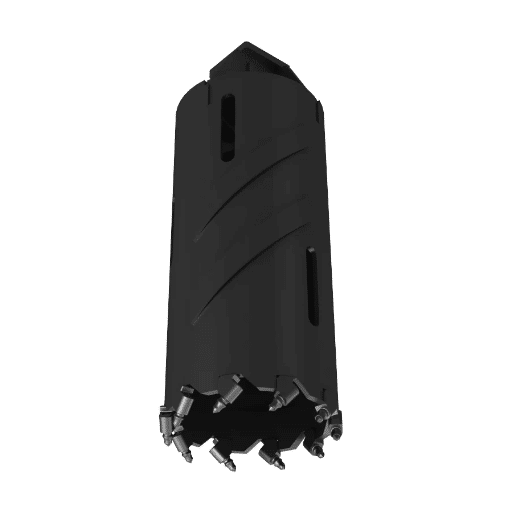
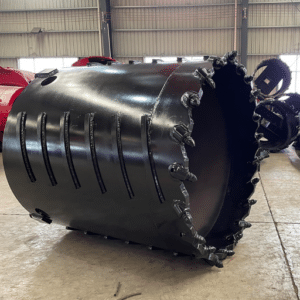
Rock core barrel drilling is a rotary foundation drilling method that cuts an annular ring of rock instead of excavating the full hole face. The cutting structure at the bottom of the barrel grinds or crushes a ring-shaped channel, leaving a solid central core inside the barrel. Once the barrel has advanced one or two meters, the crew removes the remaining core and repeats the cycle.
This method differs from auger drilling, which uses a continuous helical flight to lift soil, and from bucket drilling, which breaks and stores material inside a cylindrical body. In hard rock, full-face excavation requires too much contact area and torque. Core barrel drilling reduces the cutting surface and focuses the rig’s energy on a narrow ring, making penetration possible in rock that would stop other tools.
Contractors use core barrels for bored piles, rock sockets, bridge foundations, and high-rise piles where rock strength exceeds the practical limit of augers and buckets. If you want to see how core barrels fit alongside other foundation tools, our core barrel vs drilling bucket vs auger comparison breaks down the full selection logic.
Why Hard Rock Demands a Different Approach
Hard rock is not just “tough soil.” It behaves differently under a drill bit, and the economics change fast.
Rock Strength in MPa
Geotechnical reports describe rock strength as unconfined compressive strength (UCS), measured in megapascals (MPa):
- Soil and highly weathered rock: below 25 MPa
- Weathered to moderately hard rock: 25–60 MPa
- Hard rock: 60–100 MPa
- Very hard rock: 100–150 MPa
- Ultra-hard rock: above 150 MPa
An auger or bucket can cut economically below about 25 MPa. In the 25–60 MPa range, rock augers and rock buckets may still work, though wear accelerates. Above 60 MPa, full-face rotary tools struggle. Above 100 MPa, they become uneconomical or impossible without specialized tooling.
Why Augers and Buckets Fail
In hard rock, auger teeth and bucket teeth act as point-load cutters. They chip small fragments from the rock face. As rock strength rises, the volume of chips each tooth can remove drops sharply. The teeth overheat, wear flat, or break. Penetration rates fall below one meter per hour. The crew spends more time changing teeth than drilling.
Rahul, a piling supervisor in India, saw this on a metro project. His team tried a rock bucket in 80 MPa basalt. After 30 meters of drilling, tooth replacement costs alone had consumed 40% of the tooling budget. Switching to a bullet-teeth core barrel doubled the penetration rate and cut tooth costs by half.
The Economics of Tool Switching
The decision to switch to a core barrel is usually driven by cost per meter, not tool price. A cheap auger that drills 0.3 m/hour in hard rock can cost more per meter than a core barrel that drills 2 m/hour, once labor, rig time, and tooth replacement are included. The break-even point depends on rock strength, hole depth, and project size.
Core Barrel Anatomy for Hard Rock
A core barrel built for hard rock is more than a steel tube with teeth. Each component has to handle high torque, impact, and abrasion.
Outer Barrel / Shell
The outer barrel is the main structural body. In hard-rock applications, the shell is made from high-strength alloy steel and is thicker than standard soil barrels. Reinforced ribs or hard-facing along the exterior reduce wear when the barrel rubs against the borehole wall.
Cutting Structure
The cutting structure is the business end of the tool. Common options include:
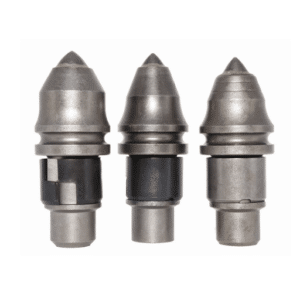
- Bullet teeth: Point-attack carbide teeth mounted on the bottom edge. They chip rock through concentrated impact.
- Roller bits: Rotating cones with hardened inserts that crush rock under weight.
- Button bits: Cylindrical tungsten carbide inserts that fracture rock under load.
The choice between bullet teeth and roller bits is one of the most important decisions in rock core barrel drilling. We cover the MPa-based selection rules below.
Inner Tube / Core Lifter
Single-wall core barrels are the simplest design: one barrel body with cutting teeth at the bottom. Double-wall and triple-tube designs add an inner tube that protects the core from washing and mechanical damage during lifting. For foundation work, single-wall and double-wall barrels are most common.
Kelly Box / Connection
The kelly box is the top fitting that connects the core barrel to the rig’s kelly bar or drill stem. It must match the rig’s torque rating and connection type. Mismatched or worn kelly boxes can transmit vibration, damage the rig, or cause the barrel to detach.
Reinforcement Features
Hard-rock core barrels often include:
- Thickened cutting edges to resist impact
- Hard-facing on high-wear surfaces
- Spiral blocks inside the barrel to grip and break the core
- Pilot teeth or central rollers to guide the barrel and reduce deviation
Need details on the teeth themselves? Our bullet teeth foundation drilling guide explains the B47K, C31HD, and BK series used in core barrels.
Core Barrel Tools for Hard Rock
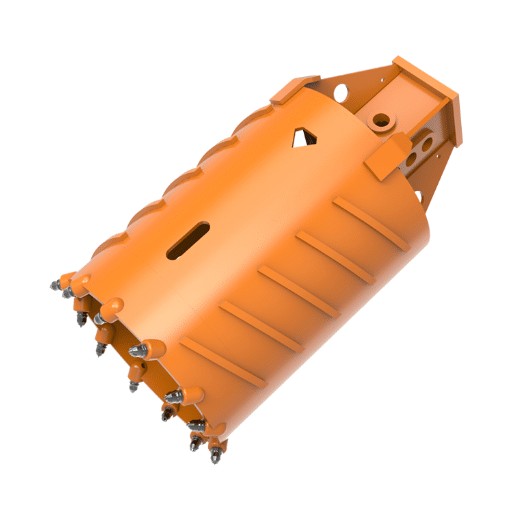
Not all core barrels are built the same. The right tool depends on the rock you are drilling.
Bullet Teeth Core Barrels
Bullet teeth core barrels use replaceable point-attack teeth mounted around the bottom rim. They are the most common choice for weathered to moderately hard rock.
Best for: 25–100 MPa rock, weathered formations, mixed ground with cobbles or boulders
Advantages:
- Lower upfront cost than roller-bit barrels
- Individual teeth are easy and cheap to replace
- Good penetration in fractured or variable rock
- Effective against reinforced concrete and obstructions
Limitations:
- Tooth wear accelerates above 100 MPa
- Penetration rates drop in homogeneous, very hard rock
- Frequent tooth changes increase downtime on long runs
Common tooth models include B47K19H for softer rock and B47K22H for harder conditions. If you want model-specific guidance, our B47K, C31HD, and BK series bullet teeth model guide covers selection by application.
Roller Bit Core Barrels
Roller bit core barrels use rotating cones with tungsten carbide inserts that crush rock under pressure. They are the standard choice for very hard, homogeneous rock.
Best for: 60–350 MPa rock, granite, basalt, gneiss, quartzite
Advantages:
- Higher penetration in very hard rock
- Longer runs between bit changes
- Lower cost per meter in 100+ MPa formations
- Crushing action handles brittle, crystalline rock well
Limitations:
- Higher upfront cost
- Bearings and seals require inspection and maintenance
- Less effective in loose or fractured ground where rollers can lock
- Requires higher rig torque and crowd pressure
Specialty Options
Some hard-rock jobs need more than a standard barrel.
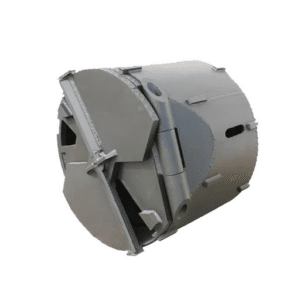
- Cross-cutters: A central cutting tool that breaks the remaining core into removable pieces.
- Pilot bits / central rollers: A guide cutter in the center of the barrel that reduces deviation and pre-cuts the core.
- Spiral blocks: Wedges welded inside the barrel that grip the core and help snap it during lifting.
- Double-wall barrels: An inner tube that protects the core and improves recovery in fractured formations.
MPa-Based Selection Framework
The simplest way to choose a rock core barrel is to match the tool to the MPa value on the geotechnical report.
| MPa Range | Rock Condition | Recommended Core Barrel | Typical Teeth |
|---|---|---|---|
| Below 25 MPa | Soil / weathered rock | Auger or rock bucket | Flat or bullet teeth |
| 25–60 MPa | Weathered to moderately hard rock | Bullet teeth core barrel | B47K19H / B47K22H |
| 60–100 MPa | Hard rock | Bullet teeth or roller bit | B47K22H / roller bits |
| 100–150 MPa | Very hard rock | Roller bit core barrel | Roller bits |
| Above 150 MPa | Ultra-hard rock | Roller bit, air roller, or cluster drill | Roller bits / specialty inserts |
How to Use the Table
Start with the reported UCS. Then consider fracture spacing and project length.
- Fractured rock drills more easily than solid rock at the same MPa. A 70 MPa heavily fractured limestone may work with bullet teeth. A 70 MPa solid granite may need roller bits.
- Short runs can justify bullet teeth even above 100 MPa if tool rental or availability is limited.
- Long runs in hard rock almost always favor roller bits because of the lower cost per meter.
A contractor in Turkey learned this on a bridge project. The geotech report showed 85 MPa limestone. The team started with B47K22H bullet teeth and made good progress for the first 8 meters. As the rock became more homogeneous, penetration dropped and tooth wear doubled. Switching to a roller-bit core barrel restored the schedule and reduced tooling cost by 35% over the remaining 22 meters.
Need help choosing between bullet teeth and roller bits? Our guide on how to choose a bullet teeth manufacturer explains what quality indicators to look for before you buy.
Hard Rock Drilling Techniques

Having the right core barrel is only half the battle. Technique controls penetration, hole quality, and tool life.
Annular Cutting and Core Formation
The core barrel rotates under downward pressure. The cutting structure grinds a ring-shaped channel around the rock face. The uncut rock in the center forms the core. As drilling continues, the core extends upward into the barrel until it contacts the core lifter or spiral blocks.
The key is consistent, controlled cutting. Too much weight on the bit causes vibration and deviation. Too little weight slows penetration and polishes the rock instead of cutting it.
Central Core Removal Methods
After the barrel advances 1–2 meters, the core has to come out. Several methods are used in the field:
Natural break and lift
If the core breaks along a natural joint or fracture, it can be lifted out with the barrel. Rapid rotation or a slight upward pull sometimes helps the core snap.
Wedge or chisel breaking
A wedge-shaped tool is lowered into the annular cut and driven to split the core. This works well in jointed rock below 100 MPa.
Cross-cutter
A specialized tool with a central chisel is run inside the barrel to break the core into pieces. A bucket or grab then removes the fragments.
Pilot bit precutting
A central pilot bit or roller in the barrel precuts the core center. This weakens the core and makes natural breakage more likely.
Spiral block capture
Spiral wedges welded inside the barrel grip the core. When the barrel is lifted, the wedges apply torque that snaps the core and holds it in place.
In practice, crews often combine methods. A roller-bit core barrel with spiral blocks and a central pilot bit will cut, grip, and break the core in one sequence more reliably than a plain barrel.
Drilling Parameter Optimization
Hard rock drilling requires a balance between torque, rotation speed, and crowd pressure.
- Torque: Hard-rock core barrels need high torque. If the rig cannot deliver enough torque, the bit stalls and polishes the rock.
- RPM: Lower RPM is usually better for hard rock. Typical ranges are 5–15 RPM for roller bits and 10–25 RPM for bullet teeth, depending on diameter and rock type.
- Weight on bit / crowd pressure: Enough downward force must be applied to keep the teeth engaged. Excessive crowd pressure causes deviation, bearing damage, and overheating.
- Flushing: Water or bentonite slurry cools the teeth, removes cuttings, and stabilizes the borehole. Inadequate flushing leads to re-grinding cuttings and accelerated wear.
A common rule: if the rig tracks start lifting off the ground, you are pushing too hard.
Step Drilling and Hybrid Workflows
Most hard-rock boreholes do not start in rock. The upper section passes through soil, clay, sand, or weathered material. The efficient approach is a hybrid workflow:
- Auger or bucket through the overburden to the rock socket.
- Core barrel through the hard rock section.
- Bucket or cleaning tool to remove the broken core and clean the hole bottom.
- Repeat the core barrel and cleaning cycle until target depth.
This sequence matches each tool to the ground it handles best. It also reduces wear: running a core barrel through 15 meters of clay to reach 3 meters of rock wastes tool life and time.
Common Hard Rock Drilling Problems
Even with the right tool, hard rock creates problems. Knowing the symptoms and fixes keeps the job moving.
Stubborn Core Won’t Break
If the core remains intact and will not lift out, the annular cut may not be deep enough, or the rock may be too homogeneous. Solutions include deepening the cut, adding spiral blocks, using a pilot bit to precut the center, or switching to a cross-cutter.
Hole Deviation / Arcing
A core barrel can wander off vertical if the weight on the bit is uneven, the barrel is too short, or the rock has inclined layers. Fixes include using a taller barrel, adding pilot teeth, reducing RPM, and checking kelly bar alignment.
Excessive Tooth Wear
Rapid wear usually means the wrong tooth type for the rock. Bullet teeth in 120 MPa granite will wear fast. Switching to roller bits or a harder carbide grade solves the problem. Poor flushing and excessive RPM also accelerate wear.
Slow Penetration Rates
Low penetration can come from insufficient torque, too little weight on the bit, dull teeth, or incorrect RPM. Check each parameter before blaming the rock.
Barrel Vibration and Damage
Vibration indicates uneven loading, worn bearings in roller bits, or misalignment. It can crack welds, damage the kelly box, and enlarge the hole. Stop drilling, inspect the tool, and correct the cause before continuing.
Cost and Productivity Considerations

Tool selection in hard rock should be measured by cost per meter, not purchase price.
Penetration Rates
Typical penetration rates vary widely by rock strength and tool type:
- Bullet teeth in 60–100 MPa rock: 2–3 m/hour
- Roller bits in 60–100 MPa rock: 5–7 m/hour
- Bullet teeth above 150 MPa: below 1 m/hour, often uneconomical
- Roller bits above 150 MPa: 3–5 m/hour in suitable formations
Tool Life
Tool life also varies:
- Bullet teeth at 150+ MPa: 20–40 meters per set
- Roller bits at 150+ MPa: 200–400 meters per set
For a 30-meter rock socket in 150 MPa granite, bullet teeth might require 5–10 tooth changes. A roller-bit barrel might complete the job on one set of bearings.
When Switching Tools Saves Money
The switch from bullet teeth to roller bits usually pays off when:
- Rock strength is consistently above 100 MPa
- The rock socket is longer than 10 meters
- Tooth replacement is interrupting the shift schedule
- Cost per meter with bullet teeth is rising above the roller-bit alternative
A project manager in Vietnam tracked this on a port expansion. The original plan used bullet teeth core barrels for 1,200 mm piles in 110 MPa granite. After the first pile, tooth costs were $180 per meter. Switching to roller-bit barrels raised the daily rental cost but dropped total tooling cost to $95 per meter. Over 40 piles, the savings covered the additional rig day and still left a margin.
Real-World Applications
Rock core barrel drilling shows up wherever foundations reach competent rock.
Granite in Southeast Asia
High-rise and infrastructure projects in Malaysia, Indonesia, and Vietnam frequently encounter granite and granodiorite. Core barrels with roller bits and spiral blocks are the standard tool for rock sockets in these formations.
Karst Limestone in the Middle East
Karst limestone is fractured, cavernous, and variable. A bullet-teeth core barrel can handle the fractured sections, but crews must watch for voids and sudden changes in resistance. Double-wall barrels help protect the core and stabilize the hole in broken ground.
Basalt in South America
Basalt formations in Brazil and Chile are hard, abrasive, and often columnar. Roller-bit core barrels with reinforced shells are common. The key challenge is deviation through inclined columnar joints, which requires careful control of weight on bit and frequent alignment checks.
FAQ
What is the hardest rock a core barrel can drill?
Standard roller-bit core barrels can drill rock up to about 250–350 MPa in suitable conditions. Above that, or in highly abrasive formations, specialized tools such as air roller core barrels, cluster drills, or DTH hammers may be needed.
How do you remove the central core?
Common methods include natural break and lift, wedge or chisel breaking, cross-cutters, pilot bit precutting, and spiral block capture. Many crews use a combination depending on rock strength and fracture pattern.
When should I switch from bullet teeth to roller bits?
Consider switching when rock strength is consistently above 100 MPa, when bullet tooth wear exceeds acceptable limits, or when the cost per meter with bullet teeth rises above the roller-bit alternative.
What rig capacity do I need for hard rock core barrel drilling?
Hard rock coring requires high torque and sufficient crowd pressure. Small rigs may struggle above 80 MPa. For very hard rock, use a rig with high torque, a heavy kelly bar, and stable mast geometry.
How deep can a core barrel drill in hard rock?
Core barrels can drill to the full depth of a bored pile or rock socket if the rig has adequate torque, pullback, and flushing. Depth is limited more by rig capacity and deviation control than by the barrel itself.
Why is my core barrel deviating from vertical?
Deviation is usually caused by uneven weight on the bit, short barrel length, worn pilot teeth, inclined rock layers, or kelly bar misalignment. Use a taller barrel, add pilot guidance, reduce RPM, and check alignment.
Conclusion
Rock core barrel drilling is the right method when foundation work reaches rock that augers and buckets cannot handle economically. The key is matching the tool to the MPa, managing the central core, and controlling drilling parameters.
Start with the geotechnical report. Choose bullet teeth for weathered to moderately hard rock, and roller bits for very hard, homogeneous formations. Use hybrid workflows so each tool works in the ground it handles best. Monitor cost per meter, not just tool price, and be ready to switch teeth or barrel type when the rock changes.
Need help selecting the right rock core barrel for your project? Contact Changsha Mingyi Machinery Equipment Co., Ltd. for technical support, customization options, and tooling recommendations matched to your ground conditions.