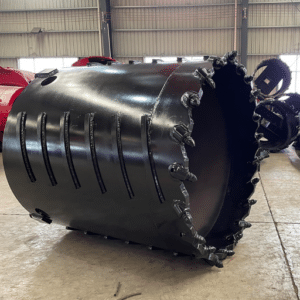
The crew in Jakarta expected clay and silt down to the pile toe. The geotechnical report showed a thin band of weathered rock, nothing the auger couldn’t handle. Then the kelly bar slowed, the rig groaned, and progress stopped at a limestone shelf no one had modeled accurately. The team tried a rock drilling bucket first. After four hours, the teeth were flattened and the borehole was out of round. They switched to a bullet-tooth core barrel the next morning. By midday, the rock socket was clean, round, and ready for reinforcement. The right tool didn’t just save the shift. It saved the schedule.
Most foundation contractors have access to augers, drilling buckets, and core barrels. The problem isn’t a lack of tools. It’s knowing which one to start with, when to switch, and why the wrong choice costs more than the right attachment. This guide compares the three main foundation drilling tools side by side. You’ll get decision rules based on ground conditions, rock strength, hole diameter, and cost, so you can match the tool to the job instead of forcing the job to fit the tool.
If you need a deeper look at core barrel types, cutting structures, and rig compatibility, our core barrel foundation drilling guide covers the topic in full.
Need help matching the right tool to your ground conditions? Contact our engineering team to discuss augers, buckets, core barrels, and custom configurations.
What Each Tool Does

A foundation drilling project rarely uses just one tool. Rotary drilling rigs can run augers, buckets, and core barrels through the same kelly bar, often in the same hole. Each tool has a different cutting mechanism, and that mechanism determines where it performs best.
Auger: Continuous Helical Cutting
An auger is a helical drilling tool that cuts the ground and lifts cuttings to the surface as it rotates. The spiral flights act as a conveyor. Soil augers and continuous flight augers (CFA) are common in soft ground, while rock augers have reinforced teeth and heavier bodies for weathered or soft rock.
The main advantage is speed in favorable soils. Cuttings leave the hole continuously, so the auger does not need to stop, lift, and dump like a bucket. The limitation is stability. In loose sand below the water table, cuttings can fall back as the auger is lifted. In hard rock, the flights cannot maintain enough pressure to cut effectively.
Drilling Bucket: Cut, Store, and Lift
A drilling bucket is a cylindrical tool that cuts material and stores it inside a closed body. A hinged bottom opens to discharge spoil when the bucket is brought to the surface. Soil buckets work in clay and sand, while rock buckets use bullet teeth or rock teeth for mixed ground and weathered rock.
The closed body gives a drilling bucket better borehole stability than an auger in wet or loose soils. It also works well with slurry or casing support. The trade-off is speed. Buckets cut and lift in cycles, so they are usually slower than augers in soft, uniform ground.
Core Barrel: Annular Ring Cutting
A core barrel is a cylindrical drilling tool that cuts an annular ring into rock or concrete, leaving a central core that is later broken and removed. Bullet-tooth core barrels handle medium-hard rock in the 50 to 100 MPa range. Roller-bit core barrels cut very hard rock above 100 MPa. Cross cutters and grabbing styles handle fractured ground and boulders.
Because the barrel removes only the outer ring, it reduces cutting area and torque demand in hard rock. The result is a cleaner, rounder borehole than a bucket can produce in solid rock. The limitation is cost and speed. Core barrels are slower than buckets or augers in soil and require more torque, crowd pressure, and operator control.
Quick Selection Matrix
Use this table as a first-pass filter. The detailed sections below explain the exceptions and trade-offs.
| Ground Condition | Best Starting Tool | Why |
|---|---|---|
| Soft clay, silt, dry sand | Auger | Fast, continuous cuttings removal |
| Loose sand below water table | Drilling bucket | Closed body prevents collapse and material loss |
| Gravel, cobbles, mixed soil | Drilling bucket / rock auger | Better stability and tooth strength |
| Weathered or fractured rock <70 MPa | Rock bucket / rock auger | Excavates broken pieces efficiently |
| Hard rock 70-100 MPa | Core barrel with bullet teeth | Annular cutting reduces torque demand |
| Very hard rock >100 MPa | Roller-bit core barrel | Rolling cutters crush and grind crystalline rock |
| Boulders, reinforced concrete | Core barrel / grabbing style | Breaks or extracts obstructions |
Augers: Best for Soft to Medium Ground

Augers are the default tool for soil drilling. Their continuous flight design makes them fast and economical on the right ground.
Common Auger Types
- Soil auger: Standard helical flights with soil teeth for clay, silt, and sand
- Rock auger: Reinforced body with bullet or rock teeth for weathered rock and mixed ground
- Continuous flight auger (CFA): Hollow stem for single-pass piling with simultaneous concreting
- Hollow-stem auger: Used for geotechnical sampling and environmental wells
When to Use an Auger
Augers work best in cohesive soils, loose to medium-dense sands, and weathered rock below about 70 MPa. They are ideal for shallow to medium-depth holes where speed matters more than sample integrity. CFA systems are common in urban projects because they produce low vibration and do not require temporary casing.
A contractor in central India used a soil auger for the upper 12 meters of a high-rise pile project. The clay was stiff but uniform, and the auger completed each bore in under 40 minutes. When the formation changed to fractured shale at 14 meters, the same auger began to stall and lose teeth. Switching to a rock auger with bullet teeth allowed the crew to finish the remaining 6 meters without a tool change.
Limitations
Augers struggle in loose sand below the water table, where the borehole can collapse as the auger is lifted. They also perform poorly in solid hard rock, boulders, and reinforced concrete. For deep holes beyond 30 to 50 meters, auger efficiency drops and tool handling becomes more complex.
Trying to decide between an auger and a bucket for your soil layers? Send us your geotechnical report and rig specs. Our team can recommend the faster, more stable option for your ground. Get a tool recommendation.
Drilling Buckets: Best for Loose, Wet, or Mixed Ground
Drilling buckets fill the gap between augers and core barrels. They handle conditions where an auger cannot maintain stability or where a core barrel would be unnecessarily slow and expensive.
Common Bucket Types
- Soil bucket: Flat or angled cutting edges for clay, sand, and silt
- Rock bucket: Reinforced body with bullet or rock teeth for mixed ground
- Double-bottom bucket: Better spoil retention in loose or wet soils
- Cleaning bucket: Removes loose material from the base before concreting
When to Use a Drilling Bucket
Choose a bucket when the ground is loose, wet, or mixed. Buckets are preferred below the water table because the closed body holds spoil and reduces the risk of collapse. They also work well in gravel, cobbles, and weathered rock where an auger would lose material off the flights.
A bridge project in Turkey encountered loose alluvial sand and gravel above bedrock. The contractor started with an auger but lost progress every time the flights were lifted; sand slumped back into the hole. Switching to a double-bottom drilling bucket with bentonite slurry solved the problem. The bucket held the spoil, the slurry stabilized the wall, and production returned to schedule.
Limitations
Buckets are slower than augers in soft, dry, uniform soil. In solid hard rock above 70 MPa, bucket teeth wear rapidly and penetration slows to a stop. They are also less effective than core barrels for forming clean rock sockets or penetrating boulders.
Core Barrels: Best for Hard Rock and Boulders
Core barrels are the hard-rock specialists. They are not designed for fast soil removal, but they are the only practical choice once rock strength exceeds what buckets and augers can handle.
Common Core Barrel Types
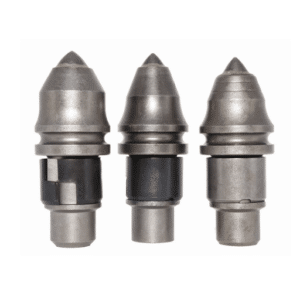
- Bullet-tooth core barrel: Tungsten carbide bullet teeth for 50 to 100 MPa rock
- Roller-bit core barrel: Tri-cone or single roller cutters for rock above 100 MPa
- Cross cutter core barrel: Intersecting arms for breaking central cores in fractured rock
- Grabbing style core barrel: Claw mechanism for boulders and loose fractured ground
When to Use a Core Barrel
Use a core barrel when rock strength exceeds roughly 70 MPa, when the formation contains boulders or karst features, or when hole quality and verticality are critical. Core barrels are standard for rock-socketed piles, bridge piers in bedrock, marine structures, and foundations that must bear directly on competent rock.
For a detailed comparison of bullet teeth used in these barrels, see our bullet teeth guide and our B47K, C31HD, and BK series model guide.
Limitations
Core barrels are slow and costly in soil. They require high torque, high crowd pressure, and effective flushing to cool cutters and remove cuttings. If the rig is undersized, a core barrel will stall, overheat, or wear prematurely.
Core Barrel vs Drilling Bucket vs Auger: Side-by-Side Comparison

| Factor | Auger | Drilling Bucket | Core Barrel |
|---|---|---|---|
| Best ground | Soft soil, clay, sand, silt | Loose/wet soil, gravel, weathered rock | Hard rock, boulders, concrete |
| Rock strength range | <50-70 MPa | <70 MPa | >70 MPa, up to very hard rock |
| Cutting action | Continuous helical cutting | Full-section cut and lift | Annular ring cutting |
| Typical speed in right ground | Fast | Moderate | Slow but productive in rock |
| Borehole stability | Lower in loose/wet soils | Higher; works with slurry | High; cylindrical body stabilizes |
| Cost per meter | Lowest in soil | Moderate | Highest, but necessary in rock |
| Depth range | Shallow to medium (<30-50 m typical) | Medium to deep | Deep rock sockets |
| Rig requirements | Standard torque | Moderate torque | High torque and crowd |
| Cuttings removal | Continuous by flights | Lifted in closed body | Broken and lifted separately |
| Hole quality | Moderate | Moderate | High in rock |
| Maintenance focus | Flight wear, teeth, connections | Bottom plate, teeth, hinges | Teeth, roller bearings, barrel body |
This table is the foundation of the decision. Soil favors augers and buckets. Rock favors core barrels. The exact transition point depends on rock strength, groundwater, and project tolerances.
MPa-Based Selection Framework
Rock strength is usually expressed as unconfined compressive strength (UCS) in MPa. The following ranges are practical rules of thumb for tool selection.
Below 25 MPa: Auger or Bucket
Soft soils, clay, loose sand, and very weak rock fall in this range. An auger is usually faster in dry, cohesive soils. A bucket is better below the water table or in loose sand.
25 to 70 MPa: Rock Auger or Rock Bucket
Weathered rock, fractured limestone, and medium-hard formations fit here. A rock auger with bullet teeth can work if the rock is fractured. A rock bucket is more stable in mixed ground and below the water table.
70 to 100 MPa: Core Barrel with Bullet Teeth
Once rock strength exceeds about 70 MPa, buckets and most augers struggle. A bullet-tooth core barrel concentrates load on carbide points and cuts an annular ring, reducing torque demand. Cross cutters can be added if the central core jams.
Above 100 MPa: Roller-Bit Core Barrel
Granite, basalt, quartzite, and gneiss require roller-bit core barrels. The rolling cones crush rock under high load. These systems need high torque, crowd pressure, and careful flushing.
A project engineer in Vietnam learned this boundary the hard way. The geotechnical report listed sandstone at 65 MPa, but the quartz content was high. A standard bullet-tooth core barrel lost 40% of its cutting points in 25 meters. After switching to a higher-grade carbide and adding hardfacing, the same barrel completed 70 meters with only one tooth replacement cycle.
Real-World Workflow: Switching Tools Mid-Hole
Most challenging foundation holes use more than one tool. The sequence follows the ground, not the tool inventory. A typical Kelly drilling workflow looks like this:
- Start with an auger or bucket in the overburden. Remove topsoil, clay, and soft fill quickly. Use a bucket if the ground is loose or wet.
- Switch to a drilling bucket in loose sand, gravel, or mixed ground. Maintain borehole stability and work with slurry or casing if needed.
- Switch to a core barrel at the rock line. Cut the annular ring to form the rock socket. Use bullet teeth for 70 to 100 MPa rock and roller bits for harder formations.
- Break and remove the central core. Use a cross cutter, rock auger, or grabbing tool to clear the core.
- Clean the base with a cleaning bucket. Remove loose cuttings before reinforcement and concrete placement.
A contractor on a 40-pile bridge project in Malaysia originally used a rock breaker-assisted bucket sequence for rock sockets. Each pile took roughly five days. After switching to a roller-bit core barrel, the same rock socket took two days. Across the project, that change shortened the foundation schedule by nearly three months.
Not sure where your rock line falls in the MPa ranges? Send us your geotechnical report. We can recommend the exact transition points and tool configurations for your boreholes. Request a technical review.
Cost and Productivity Considerations
Tool selection affects more than the attachment price. The real cost is the cost per meter, including wear parts, fuel, labor, and rig time.
Cost Per Meter
- Auger in soft soil: Lowest cost per meter; teeth and flights wear slowly in favorable ground.
- Drilling bucket in mixed ground: Moderate cost; replaceable teeth and bottom plates are the main wear items.
- Core barrel in rock: Higher cost per meter, but it avoids the much higher cost of alternative methods such as casing oscillators or down-the-hole hammers.
Downtime Cost
The most expensive tool is the one that cannot do the job. A bucket beating against solid granite wastes rig hours, wears teeth, and damages hole quality. A core barrel used in soft clay is slow and unnecessary. Matching the tool to the ground avoids these losses.
Tool Wear Patterns
- Augers wear at the flight edges and soil teeth.
- Buckets wear at cutting teeth, bottom plates, and hinges.
- Core barrels wear at bullet points, roller bearings, and barrel hardfacing.
Monitoring wear and rotating tooth positions extends service life. For contractors buying cutting tools, our guide on how to choose a bullet teeth manufacturer explains what to verify in suppliers.
Common Selection Mistakes

Even experienced crews make these errors when ground conditions change faster than planned.
Using an Auger Below the Water Table in Loose Sand
Loose sand collapses when the auger is lifted. The result is a loss of progress, oversized boreholes, and potential settlement issues. Use a bucket with slurry or casing instead.
Using a Bucket in Solid Hard Rock
A rock bucket can handle weathered rock, but it is not a substitute for a core barrel in solid granite or basalt. The teeth will flatten and the hole will go out of round.
Undersizing the Rig for a Core Barrel
Core barrels need torque and crowd. A rig sized for soil augers will stall with a 1,500 mm roller-bit barrel in hard rock. Match the barrel diameter and cutting structure to the rig capacity.
Not Planning Tool Transitions
If the geotechnical report shows rock at 15 meters, have the core barrel ready before the auger stops. Waiting for tooling costs more than carrying it on site.
FAQ
What is the main difference between a core barrel, a drilling bucket, and an auger?
An auger uses helical flights to lift cuttings continuously. A drilling bucket cuts and stores spoil in a closed body. A core barrel cuts only an annular ring into hard rock or concrete, leaving a central core to be broken and removed.
When should I use a core barrel instead of a drilling bucket?
Use a core barrel when rock strength exceeds roughly 70 MPa, when the ground contains boulders or karst features, or when you need a clean, round rock socket. A drilling bucket works in soil and weathered rock below that threshold.
Can I use an auger in hard rock?
Standard augers cannot cut solid, hard rock. Rock augers with bullet teeth can handle weathered or soft rock up to about 50 to 70 MPa, but they are not effective in granite, basalt, or similar formations.
Which is faster: an auger or a drilling bucket?
An auger is usually faster in soft, dry, uniform soil because cuttings are removed continuously. A bucket is slower because it cuts and lifts in cycles, but it is more stable in wet, loose, or mixed ground.
How do I know which tool to start with?
Start with the geotechnical report. Identify the soil types, rock strength, groundwater level, and any obstructions. Then match the weakest point in the ground profile to the tool that handles it best, and plan transitions in advance.
What is the 70 MPa rule?
The 70 MPa rule is a practical threshold: below 70 MPa, buckets and augers are usually effective; above 70 MPa, a core barrel becomes the better choice because it concentrates cutting force on a smaller annular area.
Should I buy all three tools for one project?
Not necessarily. Many projects use only one or two tools. However, mixed-ground projects often require tool switching. Rental or supplier support can fill gaps without buying every attachment.
Conclusion
The right foundation drilling tool is not the most expensive one or the one already on the truck. It is the tool that matches the ground conditions, hole diameter, rig capacity, and schedule constraints. Augers win on speed in soft soil. Buckets win on stability in wet or mixed ground. Core barrels win on hole quality and penetration in hard rock.
The key is to treat tool selection as a workflow, not a single decision. Start with the soft-ground tool, watch for the transition points, and have the next tool ready before the current one stops making progress. The cost of carrying the right attachment is small compared with the cost of a stalled rig or a damaged borehole.
Changsha Mingyi Machinery Equipment Co., Ltd. manufactures augers, drilling buckets, core barrels, and related wear parts for foundation drilling projects worldwide. If you need help selecting the right tool sequence for your ground conditions, contact our engineering team for a project-specific recommendation or quotation.