A 1,500 mm core barrel arrived on a São Paulo jobsite looking perfect on paper. The diameter matched the pile, the teeth were sharp, and the kelly box looked right. But by the third shift, the rig was stalling in hard sandstone. The problem was not the barrel quality; the rig’s torque was too low for that diameter and cutting structure. The contractor lost four days resizing the tool and replanning the sequence.
That scenario is more common than it should be. Core barrel specifications are not just numbers on a datasheet. They determine whether the tool fits the pile, the rig, the rock, and the schedule. Contractors who understand these specifications order once and drill efficiently. Those who guess by diameter alone often pay for it in downtime, wear, and rework.
This core barrel sizing guide explains the key specification parameters and core barrel dimensions, provides a practical core barrel size chart, and walks through a five-step selection workflow. You will learn how to match drilling diameter, shell dimensions, kelly box, cutting structure, and rig capacity so your next barrel performs from the first meter.
If you need help translating your pile specification into a barrel order, contact Changsha Mingyi Machinery Equipment Co., Ltd. for a custom sizing review.
What Is a Foundation Core Barrel?

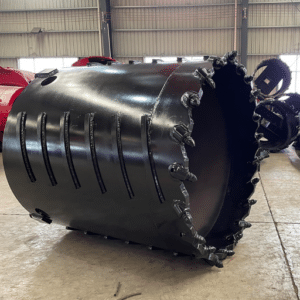
A foundation core barrel is a rotary drilling tool used in bored piling and rock-socket construction. It cuts an annular ring in hard rock, concrete, or boulders and removes a solid core from the center, allowing the borehole to advance where buckets or augers cannot.
These core barrel specifications determine how the tool performs in rock or concrete.
Foundation core barrels are much larger than geotechnical coring tools. Exploration barrels follow DCDMA wireline sizes such as NQ, HQ, and PQ, with hole diameters under 150 mm. Foundation barrels for bored piles typically start around 600 mm and can exceed 3,000 mm in drilling diameter. They connect to the rig through a kelly box rather than drill rods and are built to withstand high torque, crowd pressure, and abrasive wear.
Common applications include rock sockets for bridge piers, caissons in hard ground, boulder removal, and reinforced concrete demolition. For bored pile work specifically, read our core barrel for bored piles guide.
Core Barrel Specifications: Parameters Explained
Understanding core barrel specifications is the first step toward matching a barrel to the formation, the rig, and the pile.
Drilling Diameter and Pile Diameter
The core barrel diameter, or drilling diameter, is the nominal outside diameter of the cut. It should be slightly smaller than the specified pile diameter to allow for flushing, borehole stability, and tool clearance. A barrel that is too close to the pile diameter increases the risk of binding and reduces cuttings transport. A barrel that is too small leaves excess material in the borehole and may require reaming.
Foundation core barrel sizes commonly fall into three bands:
- 600–1,000 mm: Building piles, light infrastructure, and mini-rig work.
- 1,000–1,500 mm: Bridge piers, heavy buildings, and marine piles.
- 1,500–2,500+ mm: Large-diameter caissons, special foundations, and heavy infrastructure.
Shell diameter is always smaller than drilling diameter because the wall thickness and cutting teeth sit outside the shell. For example, a 1,000 mm drilling diameter barrel might have a shell diameter near 920 mm.
Shell Length, Shell Thickness, and Overall Height
Shell length affects how much core the barrel can take in one pass. Common lengths are 800 mm, 1,000 mm, 1,200 mm, and 1,500 mm. Longer barrels reduce the number of trips needed but increase weight and require more torque and pull-back to lift.
Shell wall thickness typically ranges from 16 mm to 25 mm, with reinforced lower bands of 30–40 mm. Abrasive formations and large diameters benefit from heavier walls. However, thicker walls add weight and reduce annular space for cuttings. The right thickness balances durability against flushing efficiency.
Overall height is one of the core barrel dimensions that is often missed. It includes the kelly box, top plate, shell, cutting structure, and any adapter. Always check the working height under the rig mast and the length available above ground when the barrel is at full depth.
Kelly Box Size and Connection Type
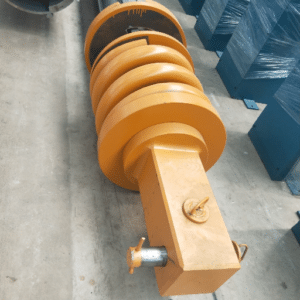
The kelly box is the square or hexagonal drive connection at the top of the barrel. It transfers torque and lifting force from the kelly bar. Common kelly box sizes include 130×130 mm, 150×150 mm, 200×200 mm, and 250×250 mm.
Matching the kelly box to the rig is essential. Adapters are available, but they add height, reduce stiffness, and can introduce play that accelerates wear. Most manufacturers can customize the kelly box to match Bauer, Soilmec, Liebherr, Sany, or other rig interfaces. For detailed selection logic, read our core barrel for foundation drilling guide.
Cutting Structure and Tooth Configuration
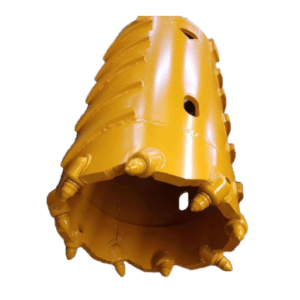
The cutting structure does the actual work. Three main types dominate foundation work:
- Bullet teeth: Tungsten carbide inserts in holders. Best for medium to strong rock, concrete, and fractured ground from roughly 50–100 MPa UCS.
- Roller bits: Rotating toothed cutters on bearings. Used for very hard rock above 100 MPa UCS.
- Cross cutters: Fixed blades that break long cores. Ideal for jointed or intact rock where jamming is a risk.
Tooth quantity and spacing depend on diameter and rock hardness. Larger diameters need more cutters for even load distribution. A 1,000 mm bullet-tooth barrel might carry 9–12 teeth, while a 2,500 mm roller-bit barrel might carry 18–24 cones.
Weight and Handling Requirements
Weight is often overlooked until the barrel needs to be lifted, trucked, or rigged. A 1,500 mm bullet-tooth barrel can weigh 1,200–1,500 kg. A 2,500 mm roller-bit barrel can exceed 2,400 kg. Larger diameters sometimes use shorter shells specifically to control weight and keep handling manageable.
Check crane capacity, transport limits, and rig mast ratings. A barrel that cannot be safely moved on site is not the right barrel, even if the specifications match the borehole.
Foundation Core Barrel Size Chart

The table below combines common foundation core barrel specifications from manufacturer references. These core barrel sizes cover typical bored-pile diameters. Values are representative; always confirm exact specifications with your supplier.
| Drilling Dia. (mm) | Shell Length (mm) | Shell Thickness (mm) | Tooth Type | Teeth/Qty. | Est. Weight (kg) | Typical Rig Torque (kNm) |
|---|---|---|---|---|---|---|
| 600 | 1,200 | 16 | Bullet | 6 | 500 | 80–150 |
| 800 | 1,200 | 16–20 | Bullet | 9 | 700–840 | 120–180 |
| 1,000 | 1,200 | 16–20 | Bullet | 12 | 975–1,050 | 150–220 |
| 1,200 | 1,200 | 20 | Bullet | 15 | 1,190–1,340 | 180–260 |
| 1,500 | 1,200 | 20 | Bullet | 18 | 1,540–1,590 | 220–320 |
| 1,800 | 1,000 | 20 | Bullet/Roller | 21–24 | 1,690–2,010 | 280–380 |
| 2,000 | 1,000 | 20 | Roller | 24–27 | 1,770–2,230 | 320–420 |
| 2,500 | 800 | 20–25 | Roller | 30–33 | 2,450–2,820 | 400–550 |
Roller-bit barrels typically require 20–40% more torque than bullet-tooth barrels of the same diameter. Use this table as a starting point, then confirm rig capacity and formation details before finalizing an order.
Core Barrel Sizing Guide: How to Size a Core Barrel for Your Project

Step 1: Start with Pile Diameter and Clearance
The first step in this core barrel sizing guide is to begin with the specified pile diameter. Subtract 20–40 mm for flushing and clearance to arrive at the target core barrel diameter. If the pile is 1,200 mm, a 1,180–1,200 mm barrel is usually appropriate. In stable rock, you can stay closer to the pile diameter. In fractured or abrasive ground, leave more clearance.
Step 2: Match Rock Strength to Cutting Structure
The next step in your core barrel specifications review is to check the geotechnical report for unconfined compressive strength (UCS) and rock condition.
- < 50 MPa: Consider a rock drilling bucket or heavy-duty auger instead of a core barrel.
- 50–100 MPa: Bullet-tooth core barrel with appropriate carbide grade.
- > 100 MPa: Roller-bit core barrel with premium bearings and hardfaced wear bands.
- Jointed or intact rock prone to jamming: Add cross cutters or choose a double-tube design.
For more on matching tools to ground conditions, see our foundation drilling tools guide.
Step 3: Check Kelly Box and Rig Compatibility
Kelly box compatibility is one of the most overlooked core barrel specifications on site. Checking the kelly box size core barrel match before ordering prevents costly adapters. Confirm the kelly box size matches the kelly bar on the rig. Common pairings include 130×130 mm for smaller rigs, 150×150 mm and 200×200 mm for mid-size rigs, and 250×250 mm for heavy-duty machines. Also verify the kelly bar type: Bauer, Soilmec, interlock, or friction kelly bars may require different adapter geometry.
Step 4: Verify Torque, Crowd, and Pull-Back Capacity
Torque is a central element of core barrel specifications because a barrel that stalls wastes time and tooling. The rig must deliver enough torque to turn the barrel against the rock. Crowd pressure forces the cutters into the formation. Pull-back force is needed to lift the barrel, especially if it jams.
A quick rule of thumb for bullet-tooth barrels:
- 600–1,000 mm: 80–150 kNm torque.
- 1,000–1,500 mm: 150–250 kNm torque.
- 1,500–2,000 mm: 250–400 kNm torque.
- > 2,000 mm: 400+ kNm torque.
Add 20–40% for roller-bit barrels. Crowd pressure typically ranges from 100 to 300 kN depending on diameter and rock strength.
When Omar’s crew in Riyadh started a 2,000 mm caisson in hard limestone, they matched the barrel to a rig rated at 360 kNm. A second contractor on the same project tried a similar barrel with a 260 kNm rig. The smaller rig stalled repeatedly and eventually cracked a tooth holder from overload. Matching torque to barrel size saved Omar’s team three days on the first caisson.
Step 5: Decide on Standard or Custom Dimensions
Finalizing core barrel specifications and dimensions means deciding whether a standard or custom barrel fits the project. Standard sizes work when the pile diameter, kelly box, and rock strength all fall within common ranges. Custom dimensions add value when:
- The pile diameter is non-standard.
- The kelly box or adapter geometry is unusual.
- The formation requires a special tooth grade, hardfacing, or wear-band layout.
- Weight or transport limits require a shorter shell or split design.
Customization does not always cost more in the long run. A barrel built for the exact conditions lasts longer and drills faster than a standard barrel forced into an unusual application.
Kelly Box Size Core Barrel and Rig Interfaces
The kelly box is a critical part of core barrel specifications and the mechanical handshake between the rig and the barrel. A poor fit creates shock loads, wear, and safety risks.
| Kelly Box Size | Typical Rig Class | Common Applications |
|---|---|---|
| 130×130 mm | Mini to small piling rigs | Restricted access, small-diameter piles |
| 150×150 mm | Small to mid-size rigs | Building piles, urban work |
| 200×200 mm | Mid-size to large rigs | Bridge piers, heavy foundations |
| 250×250 mm | Heavy-duty rigs | Large caissons, deep rock sockets |
This kelly box size core barrel table covers the most common rig interfaces.
Square kelly boxes are most common on rotary drilling rigs. Hex kelly bars exist on some older or specialized equipment. Always confirm the drive shape and dimensions before ordering. If you are unsure, supply your rig model and kelly bar size to the manufacturer. Most suppliers, including Changsha Mingyi, can machine the kelly box to match.
Standard vs. Custom Core Barrels

Standard core barrel specifications cover common diameters and kelly boxes. They are economical and fast to deliver. A standard 1,000 mm bullet-tooth barrel with a 150×150 mm kelly box is a stock configuration for many suppliers.
Custom core barrels make sense when the project has unusual requirements. Examples include:
- Odd core barrel dimensions, such as pile diameters of 1,350 mm or 1,850 mm.
- Special kelly boxes for older rigs or OEM equipment.
- Extended wear bands for highly abrasive quartzite.
- Premium carbide or diamond-enhanced teeth for extreme hardness.
- Shorter shells to reduce weight on cranes with limited capacity.
The decision between standard and custom core barrel specifications comes down to total cost of ownership. A custom barrel that matches the job exactly reduces wear, improves penetration, and avoids delays. A standard barrel that is almost right may appear cheaper but can cost more in lost time and repairs.
Sizing Mistakes That Cost Time and Money
Even experienced contractors make these mistakes when matching core barrel specifications to a project:
- Oversizing the barrel for the rig: A barrel that demands more torque than the rig can deliver will stall, overheat, and damage cutters.
- Ignoring shell length and weight: A long, heavy barrel may exceed crane or mast limits and slow every trip.
- Wrong cutting structure for the rock: Bullet teeth in granite waste time and money. Roller bits in soft clay are overkill.
- Forgetting flushing clearance: Too little annular space traps cuttings, overheats the bit, and causes jamming.
- Skipping the kelly box check: An adapter is not a substitute for a properly machined kelly box.
A maintenance supervisor in Jakarta once ordered a 1,800 mm barrel without confirming the foundation core barrel specifications. The barrel had a 200×200 mm kelly box. The rig on site had a 150×150 mm kelly bar. The adapter added 300 mm to the overall height and pushed the tool beyond the mast’s safe working envelope. The barrel sat unused for two weeks while a replacement was machined. Checking one dimension would have prevented the delay.
Core Barrel Maintenance Implications of Sizing
Core barrel specifications and sizing also affect long-term maintenance. Larger diameters with more teeth require more inspection points. Roller-bit barrels need bearing checks and periodic bit replacement. Longer shells are harder to clean thoroughly, increasing the risk of cutting buildup and corrosion.
A well-sized barrel is easier to maintain across all core barrel sizes because it operates within its design envelope. A barrel that is constantly overloaded wears faster and needs more frequent service, even when the core barrel specifications look correct on paper. For a complete maintenance framework, see our core barrel maintenance and troubleshooting guide.
Conclusion
Foundation core barrel specifications are the bridge between a pile design and a productive drilling operation. The right barrel matches the pile diameter, the rock strength, the kelly box, the rig capacity, and the handling limits of the site. When these factors align, the barrel cuts efficiently, wears predictably, and stays on schedule.
Use the core barrel size chart as a starting reference. Follow the five-step sizing workflow on every project. When standard sizes do not fit, consider a custom barrel engineered for the exact conditions. The goal is not to buy the largest or cheapest barrel. The goal is to buy the barrel that fits the job.
Need custom core barrel specifications for your next foundation project? Contact Changsha Mingyi Machinery Equipment Co., Ltd. today. Our engineering team can review your pile diameter, geotechnical report, and rig specifications to recommend the right diameter, cutting structure, and kelly box for your ground conditions.