A contractor in Southeast Asia kept losing teeth on a rock auger 12 meters below ground. The geotechnical report had warned of limestone, but the crew hoped the auger would push through. After three days of slow progress and five tooth changes, they switched to a bullet-tooth core barrel. The rock line opened up in hours, and the delay that threatened the project schedule disappeared.
That story is common. Foundation drilling tools look interchangeable from a distance, but the wrong tool turns a routine borehole into a money pit. This guide explains what foundation drilling tools are, how they work together, and how to select the right tool for your ground conditions, rig, and project economics.
You will learn the main categories of foundation drilling equipment, how to match tools to soil and rock, and what factors drive cost per meter. For a deeper look at hard-rock tooling, see our core barrel foundation drilling guide. If you are budgeting for rock tools, our core barrel price guide breaks down real 2026 costs.
What Are Foundation Drilling Tools?

Foundation drilling tools are the cutting, support, and ancillary equipment used to excavate holes for bored piles, drilled shafts, caissons, micropiles, and continuous flight auger (CFA) piles. They are mounted on rotary drilling rigs, Kelly bar rigs, CFA rigs, or excavator attachments and work as a system rather than as standalone items. The same set of construction drilling tools can be configured for soil, rock, or mixed ground by changing the cutting structure or body design.
The main categories include:
- Cutting tools: drilling buckets, augers, core barrels, and belling buckets
- Support tooling: Kelly bars, casing systems, casing oscillators, and slurry systems
- Ancillary equipment: tremie pipes, grout plants, concrete pumps, and spoil handling systems
Each category has a specific job. Buckets collect and lift spoil. Augers convey soil continuously to the surface. Core barrels cut rock sockets. Casing and slurry keep the hole open.
Choosing the right combination is what makes foundation drilling efficient and predictable.
Types of Foundation Drilling Tools
Drilling Buckets
A drilling bucket is a cylindrical tool with cutting teeth on the base. It cuts material, collects it inside the body, and lifts it out of the borehole. Buckets work well in cohesive soils, sand, gravel, and soft to medium rock. For a full breakdown of bucket types and selection, see our drilling bucket guide.
Common types include:
- Soil buckets: flat or conical bottom with soil teeth for clay and sand
- Rock buckets: reinforced body with rock teeth or bullet bits for mixed ground
- Cleanout buckets: shallow bottom for removing loose material from the hole base
- Double-bottom buckets: two-layer base that opens for faster emptying
Drilling Augers
A drilling auger uses helical flights to lift soil to the surface as it rotates. Augers are fast in soft ground and are the primary tool for CFA piles. They work best in clay, sand, silt, and soft rock. For urban piling with low vibration, continuous flight auger piles are often the preferred method.
Common types include:
- Soil augers: single or double flight for cohesive and granular soils
- Rock augers: heavy-duty flights with bullet or carbide teeth for weathered rock
- Continuous flight augers (CFA): hollow stem used for simultaneous drilling and concreting
- Short-flight augers: used for controlled spoil removal in unstable soils
Need more information? Please check out our Drilling Auger Complete Guide.
Core Barrels
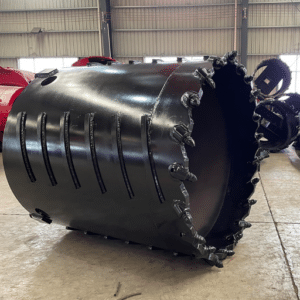
A core barrel is a cylindrical cutting tool used when boreholes reach hard rock, boulders, or dense strata. It cuts an annular ring and leaves a central core that is broken and removed.
Cutting structures include:
- Bullet teeth: best for 30–80 MPa rock
- Cross cutters: suited for 50–100 MPa layered formations
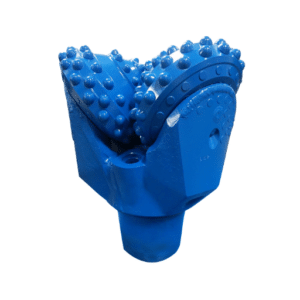
- Roller bits: designed for 80+ MPa abrasive rock such as granite and basalt
Core barrels are essential for rock sockets in bridge piers, high-rise foundations, and wind farm towers.
Kelly Bars
A Kelly bar is the telescopic drill rod that transfers torque, crowd force, and pullback from the rig to the tool. Kelly bars come in friction and interlocking types. The right bar length and torque rating determine how deep and how large a hole you can drill.
For rig compatibility, see our Kelly bar guide.
Casing Systems and Oscillators
Casing systems stabilize boreholes in loose soil, flowing sand, or high-groundwater conditions. Options include:
- Temporary casing: installed and removed after concreting
- Permanent casing: left in place as part of the foundation
- Casing oscillators and rotators: rotate casing into the ground while drilling
- Casing vibrators: drive casing through granular soils
Casing is often paired with slurry systems when soil is too unstable to stay open on its own.
Down-the-Hole Hammers and Rock Tools
For very hard rock or micropile work, down-the-hole (DTH) hammers deliver percussion force at the bit. DTH tools are common in hard-rock drilling, anchor installation, and ground improvement projects where rotary drilling tools alone are too slow.
How Foundation Drilling Tools Work Together

Foundation drilling is rarely a single-tool operation. Bored piling tools must work in sequence to keep production moving. A typical bored pile sequence might look like this:
- Start with an auger or bucket in soil or soft ground to reach the rock line
- Switch to a core barrel when unconfined compressive strength exceeds the capability of soil tooling
- Use a cleanout bucket to remove broken core and loose debris from the bottom of the hole
- Install casing or slurry if the hole is unstable or below the water table
- Place reinforcement and concrete using tremie pipes or direct placement
The key is recognizing when to switch. Continuing with a soil auger in hard rock wastes teeth and rig hours. Switching too early to a core barrel in soft ground is equally inefficient. The geotechnical report is the starting point, but operators must confirm conditions as the hole advances.
When Marcus, a project engineer in Malaysia, reviewed logs for a commercial high-rise, the report showed limestone starting at 18 meters. His crew used a soil bucket to 17 meters, then changed to a bullet-tooth core barrel. The switch took 45 minutes. Without it, they would have worn out bucket teeth in the first meter of rock and added two days to the schedule.
Matching Tools to Ground Conditions
The most important rule in tool selection is to match the tool to the ground. Below is a practical guide based on soil type and rock hardness.
| Ground Condition | Recommended Tool | Cutting Structure | Notes |
|---|---|---|---|
| Soft clay, silt | Soil auger or soil bucket | Soil teeth, clay bits | Fast penetration, easy spoil removal |
| Loose sand, gravel | Double-bottom bucket or CFA auger | Soil teeth, wear strips | Watch for collapse; consider casing |
| Cohesive clay with boulders | Rock bucket or core barrel | Bullet teeth | Switch to core barrel for boulders |
| Weathered rock, 20–50 MPa | Rock auger or bullet-tooth core barrel | Bullet teeth or carbide inserts | Monitor tooth wear closely |
| Medium rock, 50–100 MPa | Core barrel with bullet teeth or cross cutters | Bullet teeth, cross cutters | Cross cutters work well in layered rock |
| Hard rock, 100+ MPa | Core barrel with roller bits | Roller bits, tungsten carbide | Slower penetration but longer tool life |
| Fractured or karst rock | Core barrel with trap or grabbing style | Bullet teeth or roller bits | Core trap helps recover fragmented material |
Groundwater changes the equation. In dry, stable soils, an open borehole is fine. Below the water table or in flowing sand, you need casing or slurry to maintain hole stability.
Rig Compatibility and Operating Parameters
A tool is only useful if the rig can drive it. The main compatibility points are:
Kelly Box and Connection
The Kelly box is the square or hexagonal connection at the top of the tool that mates with the Kelly bar. Common sizes include 100 mm, 110 mm, 130 mm, 150 mm, 200 mm, and larger. A mismatched Kelly box means adapter plates, extra weight, and lost torque.
Torque and Crowd Force
Larger diameters and harder rock need more torque. A 1000 mm core barrel in granite can require 200 kNm or more. Crowd force pushes the tool into the ground. Too little crowd force reduces penetration; too much accelerates tooth wear.
RPM and Flush
Soft soils run at higher RPM with lower crowd force. Hard rock runs at lower RPM with higher crowd force and effective flush. Flush types include:
- Air flush: common in DTH and hard-rock rotary drilling
- Water flush: cools bits and removes cuttings in many soil conditions
- Bentonite or polymer slurry: stabilizes the borehole and carries cuttings
Matching these parameters to the tool prevents overheating, premature wear, and borehole deviation.
Foundation Drilling Tools by Project Type

Building and Commercial Foundations
High-rise and commercial projects often use large-diameter bored piles. Tooling typically includes soil buckets or augers for the upper section and core barrels for rock sockets. Low vibration and tight site access are common constraints.
Need tooling for your next commercial project? Contact Changsha Mingyi for project-specific recommendations.
Bridge and Highway Piers
Bridge piers require deep, high-capacity shafts. Rock sockets are common, so piling drilling tools for this work include core barrels with roller bits or bullet teeth. Casing is frequently used in riverbeds or loose overburden.
Wind Farm Foundations
Wind turbines need large-diameter piers with high overturning resistance. Mixed ground conditions are typical, so crews often carry buckets, augers, and core barrels on the same site. Cost per meter matters because projects involve many identical piles.
Marine and Port Structures
Marine work involves tidal conditions, saltwater, and soft sediments. Casing systems and slurry are usually essential. Tools must resist corrosion, and stainless or coated components may be required.
Retrofit and Low-Headroom Work
Urban retrofit projects may have limited headroom or restricted access. Micropile rigs, low-headroom attachments, and excavator-mounted augers are common solutions.
Cost Factors and Economics
Purchase price is only one part of the total cost of foundation drilling tools. The real metric is cost per meter drilled, which includes:
- Tool purchase or rental cost
- Wear parts such as teeth, holders, and bearings
- Shipping, import duties, and adapter plates
- Rig downtime for tool changes
- Maintenance, welding, and hardfacing
A cheap bucket that wears out twice as fast as a better-built one often costs more over the project. Similarly, a higher-priced roller-bit core barrel can lower cost per meter in abrasive rock by outlasting bullet teeth.
For current pricing on rock tools, see our core barrel price guide before you request a quote.
When Li Wei’s crew in Guangdong bought a factory-direct core barrel after renting one for a bridge job, their cost per meter across four projects dropped from 6.75 to 2.90. The purchase paid for itself after roughly 850 meters.
Maintenance, Inspection, and Service Life
Regular maintenance extends tool life and prevents unexpected failures. Key practices include:
- Daily inspection: check teeth, holders, welds, and Kelly box for cracks or wear
- Tooth wear limits: replace teeth before wear exceeds manufacturer limits, typically 5 mm or more
- Hardfacing: rebuild worn edges and cutting surfaces with weld overlay
- Cleaning and storage: remove spoil after use and store tools in dry conditions
- Rotation: swap tooth positions periodically to maintain even wear
Neglecting maintenance shortens service life and increases the risk of downhole failures that are expensive to retrieve.
Selecting a Foundation Drilling Tools Manufacturer
The right manufacturer does more than supply metal. A good partner helps you match foundation drilling equipment to your ground conditions, rig model, and project schedule. When choosing a supplier, consider:
- Material quality: high-strength alloy steel such as Q345B or Q460C for the body, quality carbide for teeth
- Manufacturing precision: CNC machining, controlled welding, and dimensional inspection
- Quality certifications: ISO 9001, material test reports, and weld inspection records
- Customization capability: ability to match Kelly box sizes, diameters, and cutting structures
- Lead times and logistics: standard sizes typically ship in 2–4 weeks, custom tools in 4–8 weeks
- After-sales support: technical guidance, spare parts availability, and troubleshooting
Changsha Mingyi Machinery Equipment Co., Ltd. manufactures drilling buckets, augers, core barrels, and related foundation drilling equipment for contractors and distributors worldwide. We focus on matching the tool to the project rather than selling standard sizes that may not fit.
Common Mistakes in Tool Selection

Even experienced crews make these errors:
- Choosing by diameter only: a 1200 mm tool is not the right choice if the rig cannot deliver enough torque
- Ignoring the geotechnical report: ground conditions determine tool type more than any other factor
- Mismatched Kelly box or thread: adapter plates add weight, cost, and failure points
- Running tools beyond wear limits: worn teeth damage holders and reduce penetration
- Skipping casing or slurry: unstable holes collapse, wasting time and concrete
- Buying on purchase price alone: total cost per meter is the better comparison
Avoiding these mistakes starts with treating tool selection as part of the engineering plan, not just procurement.
FAQ
What tools are used in foundation drilling?
Foundation drilling uses cutting tools such as drilling buckets, augers, and core barrels; support tools such as Kelly bars, casings, and slurry systems; and ancillary equipment such as tremie pipes and grout plants. The combination depends on soil conditions, hole diameter, and project type.
What is bored piling equipment?
Bored piling equipment includes the drilling rig, Kelly bar, drilling tool, casing or slurry system, and concrete placement equipment used to install cast-in-place piles by excavating a hole and filling it with concrete and reinforcement.
How do I choose the right foundation drilling tool?
Start with the geotechnical report. Match the tool to the soil or rock type, hole diameter, and rig torque. Use augers or buckets in soil, switch to core barrels in hard rock, and add casing or slurry below the water table or in unstable ground.
What is the difference between a drilling bucket and an auger?
A drilling bucket cuts and collects spoil inside a cylindrical body, then lifts it out. An auger uses helical flights to convey soil continuously to the surface. Buckets are better in granular and mixed ground; augers are faster in cohesive soils and soft ground.
When should I use a core barrel?
Use a core barrel when you encounter hard rock, boulders, dense strata, or concrete obstructions. In general, switch from soil tooling to a core barrel when unconfined compressive strength exceeds 50–80 MPa, depending on the cutting structure.
How does rig torque affect tool selection?
Higher torque is needed for larger diameters and harder rock. A tool that exceeds the rig’s torque capacity will stall, wear quickly, or damage the Kelly bar. Always match tool diameter and cutting structure to the rig’s rated torque and crowd force.
How much do foundation drilling tools cost?
Standard factory-direct prices range from roughly 2,000 for a small soil bucket to 30,000 or more for a large custom core barrel with roller bits. Total cost depends on diameter, material, cutting structure, shipping, and import duties.
What are common mistakes when choosing foundation drilling equipment?
Common mistakes include selecting tools by diameter alone, ignoring ground conditions, mismatched Kelly boxes, running worn teeth too long, and comparing purchase prices without considering cost per meter.
Conclusion
Foundation drilling tools are a system, not a collection of interchangeable attachments. The right choice depends on ground conditions, rig specifications, project type, and total cost per meter. Contractors who match the tool to the job reduce wear, avoid delays, and finish projects more profitably.
Key takeaways:
- Use augers and buckets in soil; switch to core barrels in hard rock
- Match Kelly box size, torque, and crowd force to the tool and ground conditions
- Add casing or slurry when groundwater or unstable soils threaten hole stability
- Track cost per meter, not just purchase price
- Maintain tools daily and replace worn parts before they fail
If you are planning a project and need help selecting foundation drilling tools, contact Changsha Mingyi Machinery Equipment Co., Ltd. We manufacture standard and custom bored piling tools, rock tools, and support equipment for contractors and distributors worldwide.