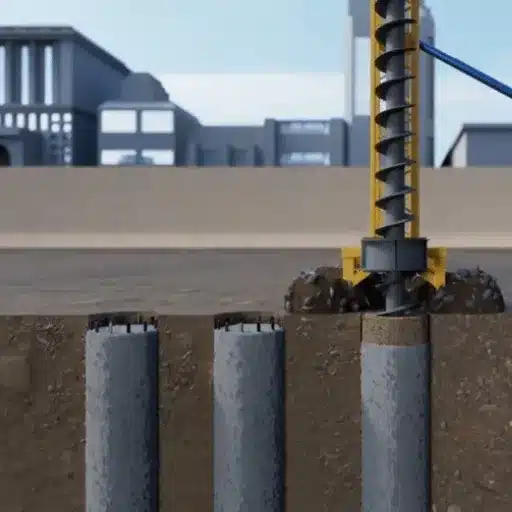
A new way to create deep foundation systems in construction developed, called “Continuous Flight Augers” (CFA) have changed the way construction companies construct their foundations. CFA Piles are a great option for construction firms looking for an environmentally sound and efficient way to support their projects through deep foundations. The blog post reviews CFA Pile’s primary features and benefits; it explains why it is quickly becoming the method of choice for all construction projects needing strong, stable foundations. CFA piles significantly reduce noise and vibration during their installation and can be installed in a variety of soils. As a result, CFA piles are able to positively affect both the time-frame and the budget of your next project. As an engineer, contractor, or project manager, read this complete guide about CFA piles and find out how they can help you save money and time on your next project.
Understanding Continuous Flight Auger (CFA) Piles

❓Tell me about Continuous Flight Auger Piles?
Continuous Flight Auger (CFA) piles are a kind of deep foundation method that is a mix of high efficiency and high strength, and as such, is most often the first option in many construction projects. They are created using a hollow-stem auger which drills into the ground and in the same time keeps the borehole from collapsing. After the borehole is grouted at the desired depth, the main auger will be pulled out and the side of the hole will be squeezed with concrete or cement, thus forming one solid piece (“piling up”). The big advantage of this method is the pile who does not cast, even in difficult conditions like those found in sands or saturated clays using the loose sands or saturated clays for challenging ground conditions and not requiring any additional supporting means for self-contained void filling.
CFA piles are usually supported by a complete steel cage or segmented reinforcement which is inserted directly into the fresh pile. They can be utilized in various projects, namely, retaining walls, load-bearing foundations, and slope stabilization, thanks to their versatility. The piles are very much appreciated not only for their installations but also for the fact that they can be very easily, quietly, and vibration-freely installed, they are an excellent choice for urban or sensitive places. Also, the one drawback of the CFA piles is that they have to be protected from the atmospheric corrosion effect on the unprotected reinforcement. Moreover, as the process is very rapid and there is the need for less equipment and manpower, the application of the method itself is less costly and friendlier to the environment than some other types of pile work.
⚙️What is the General Process with the CFA Piling Method?
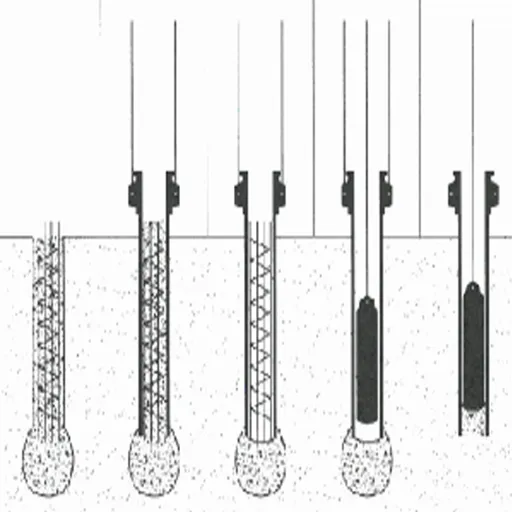
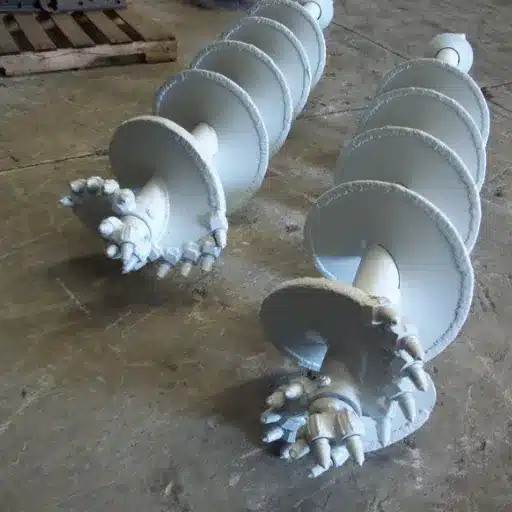
The CFA method stands for Continuous Flight Auger piles, a strategy that is using a hollow-stem auger in order to complete drilling in a constant motion thereby, the bored is kept steady all the way of the operation. The soil is driven up the flights to displace, thus the soil’s downto push directly peak is cut out through which the movement goes on. The injection drives the concrete to descend while the auger is pulled out straight out, in this way the concrete is filling up as the steel is being extracted, and the solution is under gravity and not under pressure.
After being mixed, the wet concrete is further reinforced with a steel cage inserted in it. Because of this method’s ability to provide preciseness and also to be very efficient, it can be used in most types of soils such as clay, silt, and other sandy conditions. The constant monitoring systems have sensors that provide data such as depth, torque, and pressure in real-time which enables the operators to make sure that the quality control is efficiently maintained and also to guarantee compliance with the engineering specifications. The piling and foundation industry has drastically shifted towards the use of technology, which means that even under difficult ground conditions, the pile foundations are still safe and stable.
📊Comparative View on Traditional Piling Methods
Modern methods that use continuous flight augering (CFA) and other innovative techniques are more advantageous than traditional piling methods like driven piles and bored piles. Driven piles have been used for a long time and they are good at stabilization but their vibration and noise in some cases can be heard at a great distance and might be a cause of trouble for people and animals living in surrounding areas. The noise pollution caused by this method of installation is irreversible and the pile foundation leakage could be caused by vibration during the installation proces. And, though bored piles are normally considered to be the less noisy option, most of the time, they give up their rank and the ground is supported using bentonite or casing instead, which, in turn, results in more work and higher cost.
On the other hand, CFA piling has lower disturbance through its quiet, vibration-free operation, so it is very well-fitted to the needs of not only urban but also sensitive locales. Furthermore, the auger runs continuously so that concrete or grout may be placed directly and extracted at the same time to decrease the possibility of ground fall and to provide very precise and undamaged pile diameters. These qualities contribute to the smooth and economical handling of the work, especially in the case of major or tight scheduled projects.
The development and creation of the new methods become differentiated by the modern systems in monitoring and automation even further. Live data capturing from parameters like torque, pressure, and pile depth allows for more accuracy hence, performance optimization, and reduced material wastage. These new techniques are becoming very well-fitted for demanding foundation scenarios for their use of quality checking and flexibility”. Thus, the modern technological advances have quality and flexibility as the focus, thus offering the best results in the face of difficult foundation problems.” On the other side, continuous flight auger and other methods that are very similar to it, definitely reflect a remarkable change in the field of piling technology, which has been reducing at the same time the negative effects related to the use of the very conventional methodologies.
Advantages of Continuous Flight Auger Piles
✓Vibration And Noise Lessened During Installation
Clearly one of the positive things about CFA piles is that they require very low levels of vibration and noise during the installment compared to other methodologies. The driven pile system, for instance, especially the heavy hammering, has been termed as the major source of noise pollution in the process and such a procedure is always accompanied by ground vibrations. CFA, on the other hand, uses a rotating auger to penetrate the ground. The lack of impact driving consequently makes it a perfect option for projects located in urban or sensitive areas, where noise and vibration may be a disturbance to nearby structures or residents. The lessened disturbance, also, is a significant advantage in that it serves to decrease the possibility of damage to the adjacent houses or underground facilities, thus proving the correspondence of the technique with the contemporary standards of building and environmental law.
✓Soil Compactness And Strength Improved
One of the biggest advantages of Continuous Flight Auger (CFA) piling is the fact that it contributes to increased soil compaction right at the time of piling installation throughout the whole project. The soil is being replaced with a high-quality concrete mix and the overflow consolidation of the soil around the hole being made help the soil still inside to increase its density and therefore its stability to a great extent. The process of CFA piling is a continuous one. Therefore, a CFA pile acts to strengthen a section of the ground by creating a “soil-column” which in effect increases the effective load-bearing area of the foundation. One of the striking features of CFA method is uniform load transfer, which means the structure is loaded evenly to the subsurface layers without any differential settlement over the subsoil. In some cases, researchers mention that CFA piles are actually preferred over other technologies due to their good performance that is particularly a solution for difficult conditions related to weak soils and structures. This engineering design will bring up its own utilities as a near-at-hand and dependable system for the current foundation works.
✓Cost-Effectiveness in Foundation Projects
The process of CFA piling entails injecting cement grout through the hollow stem of a continuously operating auger while the earth is removed, this is an efficient and modern method that contributes positively to the minimization of waste and to the least possible site interruption. Generally, the one factor that hinders traditional piling methods is the necessity of using casings or conducting dewatering, yet these two cannot be an issue with CFA piling anymore. As such, the method is not only faster but it also minimizes the risk of site disruption. This method of construction does not require casing or dewatering, both of which are the main concerns of traditional piling system, which means a considerable reduction in the time and cost of the project. It also provides for a more solid and evenly distributed foundation than friction piles which distributes loads to the soil over all soil transfer regions, hence eliminating the need for later strengthening work or a higher number of piles.
Disadvantages of CFA Piles
⚠Setback in the Geotechnical Conditions in Situations
Although CFA piles may serve as a versatile method of construction, they also have a number of limitations and the situation becomes even more difficult in very specific ground conditions. One of the examples is extremely hard or dense strata, where the augers could experience a great deal of resistance thus reducing the effectiveness of the installation or, at the very least, requiring specialized machinery to keep the output at a satisfactory level. The other case of very loose or unstable soils, especially those with a high content of water, is even worse because with drilling, there is higher probability of borehole falling down which can result in the pile being compromised. Besides this, compact cohesive soils of low permeability also can cause problems in respect of the uniform concrete placement, and this will call for a very close monitoring and also the use of more advanced techniques to guarantee that the results are dependable. All these factors show clearly the great importance of carrying out intensive geotechnical studies before optin for CFA piles as the foundation in a certain construction project.
⚠Probable Problems Occurring during the Pile Driving
Groundwater control during pile driving and concrete pouring is among the major hurdles in the installation of piles. Water table rise is one of the major risks in the process and it can be more than a nuisance and manifest in the form of borehole destabilization, most notably in the case of the less coherent and sandy soils. The entire problem can be solved by on-site stability maintenance through the frequent and proper use of dewatering techniques like wellpoints or sump pumps.
Variable subsurface conditions such as the existence of large rocks, hard layers or gaps might block the pile to be driven or may result in misalignment and damaged equipment. This is why it is highly critical and often necessary to carry out pre-drilling investigations and in some cases positively change the main drilling methods by employing casing or using stronger tools.
Logistical challenges, such as site accessibility and equipment mobilization, are factors that can also get in the way of installation efficiency. Less operational space in cities or unhelpful weather conditions for instance, may alter the methods of operation, the choice of equipment, and the project schedules. Moreover, advanced technologies like the real-time monitoring systems, are of a great help and necessity in the barrier-breaking process and are an assurance of the piles installed going well as planned.
Comparison of Advantages and Disadvantages
Before deciding to employ the strategy of piling, the very idea behind it all has to be carefully considered. What happens is that when piling is used, it becomes an excellent way of one to solve the load-bearing problem and it is thus a force to reckon with in areas of challenging soil and for very heavy structure projects. Moreover, the current methods of piling in the construction industry are very much dependent on high technology whereas they use vibration monitoring, damping mats for noise, and underground or overwater installation of foundation piles. These implementations have in fact brought about an increase in the construction accuracy, which in turn has led to the shortening of project duration and the safe execution of the works.
On the other side, there are significant drawbacks to think about. The start-up costs can reach very high levels due to the high capital input for acquiring the necessary equipment and hiring the right workers. Additionally, the noise and the vibrations that are produced during the driving of the piles can cause disturbances to the nearby communities especially in populous urban areas. Complex subsurface situations, such as the presence of underground utilities or very high groundwater levels, can, to an even greater extent, mess up the execution process and consequently result in time and money loss. A good way of overcoming such difficulties is for project managers to have a careful look at these factors and only then decide on the most appropriate piling method which shall then be the one providing the required strength, and at the same time, effectively facing or avoiding potential difficulties.
Applications of Continuous Flight Auger Piles in Construction

Residential and Commercial Building Foundations
Choosing Continuous Flight Auger (CFA) piles for building the foundations of residential and commercial structures has gained popularity because of the adaptability, efficiency, and environmental friendliness of the process. More and more these piles are the best option when constructing in the middle of a city where noise and vibration reduction are essential issues. The use of a continuous helix auger allows CFA piles to be put in place with the least possible damage to the surrounding structures thus being the best selection for the very crowded regions.
This method of foundation lays the groundwork for soils almost without restriction and is robust enough to work in different soil conditions efficiently, e.g. with loose and granular materials or cohesive ones with clay. Its implementation comprises drilling to the specified depth while simultaneously putting concrete into the borehole under pressure and drawing the auger out. The whole system is seamless, and it not only secures the integrity of the borehole but also decreases the danger of soil collapse and allows for the creating of piles of exactly the same diameter.
The unquestionable choice in the residential and commercial sectors, among others, is the construction of multi-story buildings, office spaces, and the apartment complexes all of which have a demand for solid and dependable bases. On top of that, CFA piling can easily fit into the fast-track programs thanks to its fast paced installation which does not need casing or the pre-drilling in favorable ground conditions. The combination of the technological advantages and flawless operations is what makes the CFA piles a frequent option in the construction of the modern foundation system.
Bridges and Infrastructure projects
CFA piles are commonly used for building bridges and other infrastructure projects because of their ability to give the structure a strong, stable foundation, and simultaneously be adaptable to different geological conditions. For the problem of high load demands, irregular terrain, or areas with minimal vibration such as urban or sensitive environments, these piles can be good mainstays. The process of continuous flight auger ensures that there is minimal disturbance of the soil resulting in less stress on the surrounding structures and subsurface conditions. Similarly, any development in the design of piles and real-time monitoring technologies assists in gaining more accuracy of CFA pile installation thus, making it to be a better option when it comes to infrastructure development. All of this tech change has actually made CFA piles very good choices for critical infrastructure systems where ductility and efficiency are the first priorities.
Environmental Considerations in CFA Applications
More and more people realize the benefit of Continuous Flight Auger (CFA) pile foundation method over other processes since it’s less harmful to the environment. Noise and vibrations are among the environmental pollutants during the installation but by performing piling with CFA they can be minimized to the extent where they hardly affect neighboring ecosystems and nearby buildings in critical settings. Moreover, since the CFA approach reduces the required amount of excavation and thus waste removal (that are associated with the extensive transportation of materials), it also contributes to reduced carbon emissions.
Eco-friendly grout mix formulations become more environmentally friendly with the use of fly ash or blast furnace slag in addition to the reduction in the use of Portland cement. portland cement is a big emitter of CO2 in the construction industry. Also, the state-of-the-art PFA plants use monitoring tools to make sure the material is used in the best possible way, hence, minimal waste and precision in the construction of piles are observed.
All the cutting edge ingredients enable CFA piling not only to stand out as the most demanded construction method but also to comply with green construction practices. Technically speaking, such a shift in the construction setting is already being done by engineers and project managers who choose to adhere to strict environmental laws and to achieve sustainable green goals.
Best Practices for Auger Drilling and CFA Installation
Pre-Drilling Site Assessments
From my experience, one of the very necessary measures is a very detailed pre-drilling site assessment for those piling systems that use the Continuous Flight Auger (CFA). It is through this a process that the effectiveness as well as the efficiency of the project can be confirmed. The initial phase includes a thorough geotechnical investigation to assess the subsurface conditions. The investigation will involve the testing of soils, the analysis of boreholes, and the getting to know what stratigraphy is like to reveal the load-bearing capacities and the possible challenges that might be faced if ground water levels or the composition of soil vary. Elaborate geotechnical reports are the prominent source on the basis of the selection of equipment configurations, the auger specifications, and the grout mix designs ‘tailored’ to the site conditions.
From a practical perspective, the focus is always on ecology when I assess sites. Working the closeness of neighboring structures, utilities, and areas with fragile ecosystems into the planning greatly reduces the risk of problems arising during drilling. It is also essential to check the logistics of the site in regard to access and layout, as this will lead to the best positioning of equipment and materials and hence to construction efficiency. Prior to drilling, all these preliminary investigations have to be in-line with the mandatory regulations and safety standards, respective to which the activity keeps aligned with the laws and environmental guidelines.
My last suggestion is to take into account advanced predictive modeling tools for simulating the pile installation process. These tools will help to identify potential discrepancies and refine design parameters and get their use fulfilled in the future. Eventually, by combining both traditional as well as modern techniques, the site assessments of pre-drilling will be able to greatly increase the quality and sustainability of CFA piling projects.
Headings and Subheadings for Formatting and Organization
According to my own experience, planning of every drilling and grouting operationis crucial for achieving the success. Only it should be done accurately. Therefore, the operational environment should be prepared and the advanced technologies must be integrated. The adoption of a comprehensive site investigation system will pave the way for the drilling process to be successful. Geotechnical surveys and borehole logging make the drilling process easy. Soil or rock properties permitting the selection of drill bits and equipment is the final step in the site investigation and the beginning of the drilling process. Modern drilling equipment is essential to the success not only for the fast penetration but also for the maintenance of the borehole stability by using sophisticated anti-vibration and noise cancellation technologies
When it comes to grouting, I am following a fusion of old-school and state-of-the-art approaches. Getting the right mix is a priority; for this, I tend to go for the right water-cement ratio and the use of chemicals like plasticizers and microfine cement to get an easy-flow mix with a strong bond and a long term life. In the process of placing grout at the right spot, I make use of pressure-control systems with live monitoring to control and keep injection pressures steady. This strategy is effective in preventing void migration, and it guarantees a consistent bond between the grout and the surrounding substrate.
Besides the above, the use of sophisticated technology such as computerized grout monitoring systems, among others, gives flow rates, pressure, and volume injected data continually, also permitting better accuracy and quality control. In addition, the maintenance process, which includes non-destructive techniques e.g., ultrasound and pulse velocity testing, can also prove the stability of the grout. By these methods, I am able to maintain the best performance, robustness, and long-lasting stability of the structure for any project.
Monitoring and Quality Control in Installation
To make sure that installations are done according to the highest standards I employ the most modern technologies and systematic procedures that make it possible to do the work in real time and with precision. For example, I use automated monitoring systems with sensors that monitor and send real-time data about flow rates, pressure levels, and material volumes. This data also helps the process become more controllable because instant analyses can be made and immediate adjustments can be done. Moreover, I also use real-time data visualization tools that help me to get a whole picture of my operation, and detect easily if there are patterns or anomalies that can lead to a bad installation quality.
Quality control is even more enhanced through the use of non-destructive testing (NDT) methods. Some of the most effective methods in the process are the techniques followed by the ultrasonic pulse velocity test and ground-penetrating radar. However, by using these approaches, it is now possible to identify the weakness of structures without damaging them. Additionally, the methods can act as a barrier to the intrusion of voids, weak zones or other forms of degradation which can be caused by different curing conditions or uneven injection flow. As a result, the distribution of materials for better adhesion can be made through timely detection and settlement of the problems. In this way, the very strict quality assurance guidelines will be met, which is a sign of high-quality production.
Additionally, the quality management strategy I am working on has documentation and standards compliance as its core. Every move in all stages of the process is regulated by standards of the industry that are relevant to the field like ASTM and ISO, to make sure that the project complies fully with the necessary legal and safety requirements. The computerized system-produced detailed reports which provide a transparent record of all processes could be turned into a reference for inspections or audits happening in the future. The use of leading-edge technology in conjunction with strict quality control methods allows me to make sure that the installation will be safe and steady over the long run, thus, I can guarantee the structural integrity and long-term resilience of the installation.
Reference Sources
-
Design And Construction Of Continuous Flight Auger Piles – A comprehensive manual on the design and construction of CFA piles.
-
Continuous Flight Auger Pile Bridge Foundation – Discusses the advantages of CFA piles compared to other pile types.
-
2002 Scanning Project Innovative Technology for Accelerated Construction – Highlights the use of CFA piles in bridge construction and their technological advancements.
Frequently Asked Questions (FAQs)
What are the differences in the performance of continuous flight auger and auger cast piles for differing soil types?
The methods of continuous flight auger (CFA) and auger cast piles altogether are meant to be used for a very large range of soil conditions, such as cohesive clays, and some of the granular soils but with the softer kinds of soils being more preferred. The process of CFA involves the creation of a hollow stem auger, which is the one that goes through the ground, and a hollow stem for the concrete to be pumped through making a continuous pile. Also, it helps with the borehole stability in the soft soils. If the soil is full of gravels or cobbles, casing or driven piles would probably be better because the auger may not be able to penetrate it and the soil removal would be hard. In situations where the working is close to the urban areas and environmental impact is immediate, the use of the method means that the noise levels are lower and the vibration is reduced, compared to the vibration and noise that are produced when the driven piles are used. The load-bearing capacity of the pile is increased when reinforcement cages are used, especially in cases where the structural integrity and tension loads are to be assured.
What are the advantages and disadvantages of CFA auger cast piles for foundation drilling?
The continuous operation is one of the main pros of using CFA auger cast piles, next to the relatively speedy installation of piles and the opportunity to pour concrete or grout directly through the auger thus creating a continuous pile without spoiling removal. Besides the loud noise generated, the vibration caused by the CFA drilling process is a matter of great concern in the surrounding area. The other problems associated with this type of drilling are the tendency for groundwater to seep into the borehole which makes it logistically difficult to remove the spoil during the drilling process, and the need for a high discharge rate of bentonite to stabilize the borehole walls. The size of the bentonite piles accumulating around the periphery of the borehole has raised environmental concerns particularly in urban areas where borehole diameters are typically small. The possibility that the drilling fluid may contaminate groundwater or soil has also been raised as part of the argument against the free-flow slurry platforms which are prevalent in the urban setting.
Can auger drilling with auger-cast piles meet high structural integrity and reinforcement requirements?
Indeed, if associated with steel reinforcement cages, auger drilling with auger cast piles can provide the required high resistance to bending and tension that are required for bearing in any situation, once the design and executive procedures are properly followed. The method is basically the same as all the piles using concreting process, i.e., it doesn’t include continuous vibration of the pile shaft to force concrete to submerge; instead, the concreting is done simultaneously with the withdrawal of the auger, and a continuous pile formed with the concrete that has bonded with the soil and that can bear the load reliably. In the case of a larger diameter or higher load, a steel cage is a must to meet the structural strength as conventional. The alternative to plain grout-fill with reinforcement piles greatly depends on the design loads, ground conditions, as well as the standards of the foundation construction industry. When inspected correctly, these piles can be a solution for a variety of different types of foundation needs in construction projects.
How does the level of vibration and noise differ between CFA auger cast piles and driven piles?
As a general rule, CFA auger cast piles produce far less vibration and noise than driven piles. It is due to the fact that the former is a method of drilling a hole and then filling it up with concrete while the latter is a method of pounding the dam parts into the ground repeatedly and approximately through hammering. The use of the continuous auger method also reduces the risk of affecting the existing structures and these areas hence lowering the adverse environmental impact on downtown or limited space constraints. The reason is that not only is the concrete being pumped through the hollow stem, but also the auger being pulled out to make the pile, delighting the process and lessening the ground shock inflicted by the piling hammer strokes. In the situations when the least possible interference is very important, these piles are commonly the agreed upon base whereas the alternate piles and other noisy methods are rejected. This less noisy procedure also increases the production rate in sound restricted areas and still maintains the required bearing capacities.
What installation process and equipment are required for continuous-flight auger-cast piles?
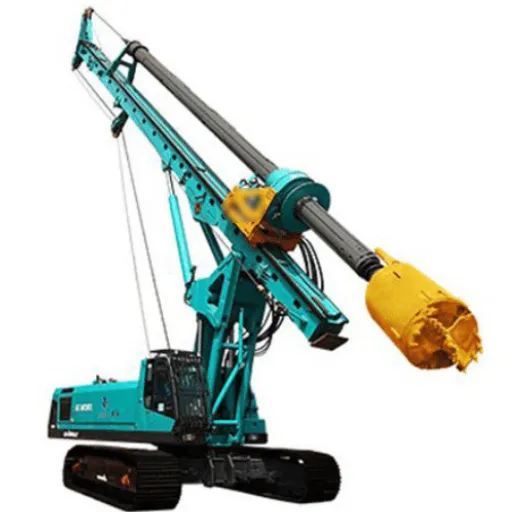
The rotary drill rig is at the heart of the pile installation with a continuous flight auger and the process of casting piles is associated with the rig. So, along with a hollow stem auger, a rig and concrete or grout pumping equipment are of primary importance. Moreover, to a large extent, and often even a reinforcement cage insertion setup are required for reinforced piles. To sum up, the establishment of a reinforced pile is the dominant factor taking all phases of pile formation into account along which hollow and octagonal variants of the drilling pipe may be included.
Are continuous auger-cast piles suitable for deep foundations and varying ground conditions?
The uses of Continuous Flight Auger (CFA) piles are very general in the case of a deep foundation since they can be modified for a lot of different soil and construction requirements. This makes them an ideal solution for construction projects of different sizes. The method is the process by which the machine augers continuously and can also be used with casing or different types of drilling when the bore hole goes through a difficult formation or there is a high water table. Designers not only look at the soil conditions, but also decide whether reinforcement cages will be needed, and they design a method for which grout, or concrete, will be pumped to produce the pile with the specified load-bearing and tension load requirements. These applications are also adaptable to the buildings with row materials that are not cohesive but by proper planning, the problem can also be solved. Moreover, it is worth mentioning that fast and simple methods are available when embarking on constructions similar to the ones that have been done previously or the ones that are at their normal level. It is done that foremost pile cannot be driven, other methods can be used by simply making a comparison of them. However, it is still the case that they can be more advantageous to use a number of techniques with varying degrees of difficulty rather than to apply a single technique all over. In essence, Auger cast piles are a versatile, quite low-inducing and yet effective foundation construction method for soil types and project sizes alike.