Among the various types of deep foundations, auger pile foundations, more specifically, auger cast piles, take the lion’s share in modern construction projects that require both stability and accuracy. With their exceptional capability of carrying heavy loads, these foundation systems plus the fact that they are less disruptive to the environment, make them a necessity in the construction industry that is modern, fast-changing, and ecologically-minded.
The interested readers of this blog post are going to read about the principles at the heart of auger cast piles, their use, and the benefits derived from them. Specifically, the paper will discuss their design, adaptability to different soil conditions, and the application of cutting-edge technology to their installation among others. Whether you’re a construction expert, a designer, or merely interested in the subject of modern foundation methods, this guide will give you an in-depth understanding that is both reliable and enriching.
Introduction to Auger Pile Foundations

Auger pile foundations are the types of deep foundation systems that are made by boring a hollow stem auger into the soil to the necessary depth and afterwards pouring the concrete into the hole while the auger is pulled out. This technique greatly reduces the impact on the land and is especially beneficial when building on difficult or soft ground.
What is an Auger Pile?
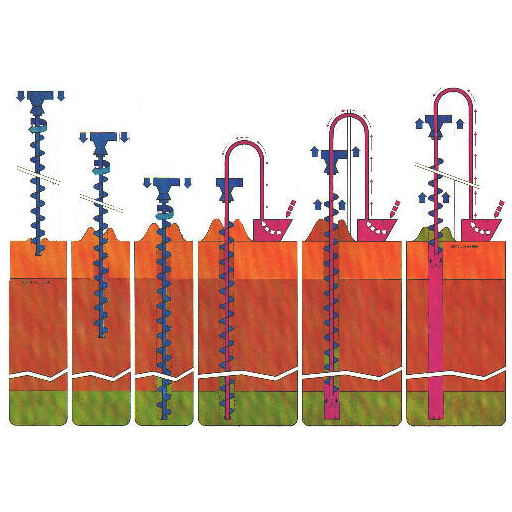
An auger pile, also referred to as a Continuous Flight Auger (CFA) pile, is considered a category of deep foundation system that comes in handy during construction processes to shift the loads from a building to the stable, sub-surfaces layers. The whole procedure is mainly drilling the ground using a hollow stem auger, which gets rid of the soil and at the same time keeps the area around the borehole stable.
When the required depth is reached, concrete or grout is pushed up through the hollow stem of the auger as it is being taken out, thus a column of reinforced structural material is created. Steel cages or bars, for example, can be reinforcement after the concrete has been poured into the pile to increase its load-bearing capacity.
This method is particularly suitable for:
- Construction that requires vibrations and noise to be kept at a minimum
- Urban or residential areas
- Installation in a wide range of soil types including hard-to-drill cohesive and dense sand soils
- Projects requiring rapid installation for efficiency and cost-effectiveness
Benefits of Using Auger Cast Piles
The advent of auger cast piles in construction projects has brought about many measurable benefits, which are evidenced by new data and trends. The following advantages make them increasingly popular in modern construction:
| Benefit | Description |
|---|---|
| Minimal Vibration & Noise | Perfect for urban or sensitive areas where disturbance must be kept to a minimum, especially near existing buildings or residential developments |
| Quick Installation | Cuts down project duration, leading to financial and efficiency gains |
| Load-Bearing Capacity | Guarantees stability for both vertical and horizontal loads—significant for high-rises, bridges, and heavy structures |
| Versatility | Can be used in a range of subsurface conditions, including weak soils with high cohesion or density like hard clay or compacted sand |
| Quality Control | Vigilant supervision and regulation of the grouting process during installation results in superior quality and longevity |
The recent technology trends focusing on automation and monitoring have aided in making these systems even more accurate and reliable. Engineers are using real-time data collection and advanced pile stress monitoring to fine-tune installations, which will not only diminish material waste but also ensure structural standards’ compliance.
Applications of Auger Piles in Construction

1. High-Rise Building Foundations
The high-rise edifices which are designed to cut through urban landscapes are still managing to be supported by auger cast piles which are very deep and hence, the structure’s vast weight gets evenly distributed over the site. That is the case in the city where the construction of buildings is an efficiently done foundation by using auger cast piles due to space limitations.
2. Bridge and Overpass Support
With the ability to withstand huge dynamic and static loads, the auger cast piles are the major players in the bridge and overpass constructions. Their support in the fluctuating ground conditions will give these structures a long life and safety.
3. Industrial Facility Construction
The construction of big manufacturing and processing plants often attracts the need of heavy machine and equipment suitable foundations. Auger cast piles are the perfect support for such factories, lessening the danger of settlement and providing the stability needed for operations.
4. Marine and Waterfront Structures
When it comes to docks, piers, and other waterfronts projects the use of auger cast piles is for sure driven by the benefits they have in terms of speed. The piles penetrate soft, saturated soil very quickly and hence works in favor of the project. Their application also guarantees the life span of the project since it is resistant to the environment factors like water erosion.
5. Retaining Walls and Slope Stabilization
The method of constructing retaining walls and stabilizing slopes with auger cast piles is an effective one. Anchoring deep into the firmer soil layers, they give the reinforcement that is very much needed to resist soil movement and erosion, especially in the regions where landslides are likely to occur.
Types of Auger Piles
Continuous Flight Auger (CFA) Piles
CFA piles are made by boring into the earth with a constant auger while at the same time injecting concrete through the hollow stem as the auger is pulled out. This technique guarantees constant support of the borehole and is particularly applicable for preventing soil collapse in loose or granular grounds. CFA piles are extensively used in urban building projects since they produce no vibration and are suitable for silence-sensitive areas.
With the advent of modern monitoring systems and real-time data collection, precision, efficiency, and compliance with engineering standards are the benefits of modern CFA pile installations, thus making them the most popular choice in many geotechnical applications.
Segmental Auger Piles
These piles make use of sectional auger equipment that enables deeper penetration into the earth. They are perfect for projects that need more depth and load-bearing capacity. The segmented design allows for excavation through harder soil layers or taking underground obstructions out of the way.
Displacement Auger Piles
Displacement auger piles push soil to the side during installation instead of removing it. This process packs the neighbouring soil down, which can lead to an increase in load-bearing capacity and a decrease in settlement risks. This technique is preferred where reduced spoil removal and site contamination are of prime concern.
Mini Auger Piles
Mini auger piles are small diameter piles designed for projects with restricted or difficult access. They are regularly used for underpinning foundations and in retrofitting applications.
Hollow-Stem Auger Piles
Hollow-stem auger piles belong to the category of deep foundation systems that are particularly specialized and thus have a wide use in geotechnical and construction projects. The installation of these piles is done with a hollow-stem auger, which is a drilling method that permits the simultaneous process of drilling and grouting or capturing soil samples without the use of a casing.
Installation Process of Auger Piles

The process of installing auger piles calls for a sequence of actions that are very important to the project and even more important when one is working with difficult soil conditions.
- Positioning: Position the auger at the pile location, determined by precise geotechnical and structural assessments
- Drilling: Rotate the auger into the soil, displacing the soil while moving down to the required depth
- Monitoring: Continuously monitor torque and penetration rates to detect obstructions or differences in soil layers
- Concrete Injection: Once target depth is accomplished, inject concrete or grout through the hollow stem as the auger is removed
- Reinforcement: Insert reinforcement cages into the freshly poured concrete or grout before it hardens
- Quality Control: Use real-time data recording systems to control parameters like flow rates, pressure, and depth
Drilling Techniques for Auger Cast Piles
The auger cast pile drilling technique makes use of continuous flight augers for the purpose of soil excavation and the creation of a pile shaft. The auger drilling process is first initiated by drilling into the ground to the predefined depth which is ascertained by geotechnical conditions of the site.
Key factors for drilling precision:
- Real-time monitoring in auger drilling
- Minimizing over-excavation risks
- Continuous measurement of auger rotation speed
- Monitoring grout pressure and depth accuracy
Quality Assurance during Installation
The quality control during the installation of auger cast piles is a very vital step that guarantees the structure’s soundness and adherence to the engineering standards. Modern invention technologies are put to use for evaluating the principal factors which are the speed of auger rotation, penetrating rates, and pressure of grout in real time.
Quality Assurance Methods:
- Automated systems with cloud-based platforms for real-time monitoring
- Geotechnical tests including load testing and soil analysis
- Remote quality control and adjustments
- Comprehensive documentation at every installation step
Soil Conditions and Their Impact

Soil’s characteristics and its makeup are directly responsible for the determining factors like the project’s stability, construction’s load-bearing capability and the overall performance of the projects under construction.
Assessing Soil Conditions for Auger Pile Installation
The soil condition assessment is the most important factor in auger pile installation planning to ensure that the structures are stable and will perform well in the long run. Soil characteristics like soil type, moisture content, density and load-bearing capacity are the most important factors that determine the appropriateness of the soil for auger pile installation.
| Assessment Method | Purpose |
|---|---|
| Standard Penetration Tests (SPT) | Determine soil density and strength |
| Cone Penetration Tests (CPT) | Measure soil resistance and stratification |
| In-Situ Vane Shear Tests | Assess undrained shear strength |
| Ground-Penetrating Radar (GPR) | Identify underground conditions and obstructions |
| Pressuremeter Testing | Evaluate soil deformation properties |
Adapting to Varying Soil Types
The process of adapting to different soil types entails a thorough geotechnical knowledge and the use of sophisticated technologies to analyze soil behavior. The main soil parameters, i.e. cohesion, permeability, compactness, and the ability to bear the weight, might be quite different in different construction sites.
Impact of Soil Conditions on Foundation Support
Cohesive soils like clay have very large volume changes with moisture content variation and cause instability in foundations. Meanwhile, granular soils such as sand give less variable but lower support which at times is their weakness during dynamic loads. Engineers can now easily locate the relevant case studies, innovative stabilization techniques, and predictive modeling tools to tackle such difficulties.
Project Requirements for Auger Pile Foundations
Precision in geotechnical analysis, accurate load-bearing calculations, and adherence to environmental regulations are the basic requirements of the project. Auger piles should take into consideration the parameters specific to the site such as:
- Soil layers composition and characteristics
- Water table levels
- Possible forces acting laterally
- Load-bearing requirements
- Environmental regulations and constraints
Cost Considerations and Budgeting
Evaluating the cost of construction methods is a comprehensive process that requires taking into account several aspects in order to meet both financial and technical, or project, requirements. Continuous flight auger (CFA) piles are more affordable than other traditional methods such as driven piles or bored cast-in-place piles.
Cost factors include:
- Reduced machine idling time
- No dirt hauling requirements
- Engineering assessments
- Material type and quality
- Testing procedures for safety standards
- Long-term maintenance requirements (usually lower for CFA piles)
Regulatory Standards and Compliance
When determining regulatory norms and compliance for construction methods like Continuous Flight Auger (CFA) piles, it is very important to observe national and international guidelines at the same time.
Key standards include:
- ISO 9001: Total quality management
- ISO 21930: Sustainability in construction
- Eurocode EC7: Geotechnical Design
- AISC: American Institute of Steel Construction specifications
References
-
Design And Construction Of Continuous Flight Auger Piles
Link to source
This manual provides detailed insights into the design and construction practices for continuous flight auger (CFA) piles. -
Continuous Flight Auger Pile Bridge Foundation
Link to source
A study verifying the use of ACIP piles as an alternative to driven piles for bridge foundations. -
Design and Construction of Auger Cast Piles – Purdue e-Pubs
Link to source
Frequently Asked Questions (FAQ)
What is an Auger Pile Foundation?
An auger pile foundation is a deep foundation form that employs a massive drill, called an auger, to make vertical holes in the earth. The holes are filled with concrete forming piles that are strong and resilient, providing support to different structures such as houses and commercial buildings. This technique is very effective for soils which are otherwise unfit for any sort of conventional foundations.
How do Auger Cast Piles Work?
Auger cast piles popularly referred to as continuous flight auger (CFA) piles are made by burying the hollow stem auger with continuous flights into the earth’s surface. Concrete is pushed through the hollow stem to occupy the space left by the auger as it is pulled out. This process permits instant pile installation and provides a robust foundation solution with very less disturbance to the surrounding earth.
What are the Applications in Construction for Auger Piles?
Auger piles serve as the backbone of many construction projects from foundation to structure including residential and commercial buildings, bridges, and industrial structures. In addition, they are great in the case of soil-rich environment areas because they are non-invasive, silent, and disturbance-minimizing. On top of that, they are even applicable in ground modification where they lend their strength to the soil that is otherwise not easy to deal with.
What Factors Affect the Installation of Auger Piles?
The installation of auger piles is primarily influenced by the soil conditions, the project, and the type of rig that is used for drilling. The specific project timelines and the nature of the foundation will dictate the equipment and techniques used. Quality assurance during the installation process is of utmost importance to guarantee the reliability and performance of the foundation system.
Are Helical Piles a Good Alternative to Auger Cast Piles?
Helical piles may act as a replacement to auger cast piles, particularly in cases where there is a demand for immediate load-bearing support. Their design includes a helical-shaped plate that facilitates easy installation in all types of soil. However, the decision-making process on helical versus auger cast will depend on the ground conditions and project requirements.
What is the Difference Between Auger Piles and Hollow Stem Auger Piles?
While both auger piles and hollow stem auger piles have one thing in common – drilling into the ground- they differ in the construction process employed. Hollow stem auger piles subject a drill that has a hollow center where through the concrete can be placed at the same time as the auger is being drawn out. On the other hand, traditional auger piles may demand separate withdrawal placement after drilling.
How are Auger Piles Beneficial in Environmentally Sensitive Areas?
Auger piles are particularly favorable for installation in such areas, where the habitat is delicate, since they cause little noise and do not disturb the soil. This process minimizes the effect on fauna and aquifers around the project site, thus making it the most suitable technique for projects located at coasts or in wildlife sanctuaries.
What Quality Assurance Measures Should Be Taken During Auger Pile Installation?
Quality assurance measures in the course of auger pile installation consist of monitoring soil conditions, utilizing calibrated equipment, and performing load tests after install. Proper paperwork and inspection guarantee that the ground works meet the required specifications and that they are capable of performing under heavy load; this ultimately is one of the factors that determine the lifespan of the building.