Rahim watched the rig torque climb past 80 kN/m on a sticky September morning in Dhaka. The solid stem auger had been chewing through stiff clay for twenty minutes, but the advance rate had dropped to almost zero. When the crew finally pulled the string, the flights were caked with a solid cylinder of clay, bent into a tight ball around the stem. Half a shift lost. The problem was not the soil. It was the tool.
If you have ever stood next to a rig and wondered why one soil auger drilling setup flies through sand while another chokes on clay, you already understand the real challenge. Soil auger drilling is not about power alone. It is about matching auger geometry, rotation speed, and torque to the specific soil behavior in front of you.
In this guide, you will learn how soil auger drilling works, which auger type fits each soil class, what rig specifications you actually need, and how to avoid the field problems that destroy productivity. We will cover solid stem, hollow stem, continuous flight, and bucket augers with the quantitative tables that help you make fast, confident decisions on site.
What Is Soil Auger Drilling?
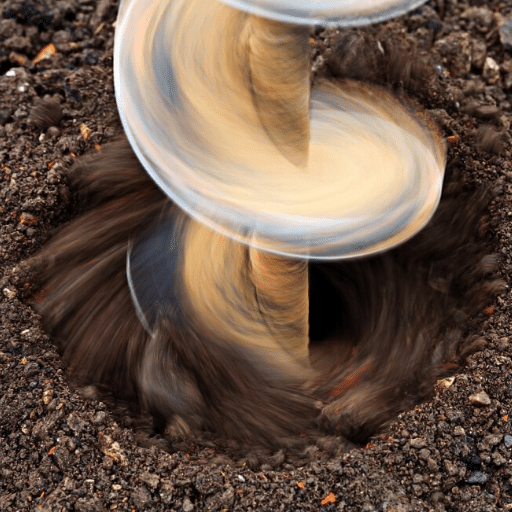
Soil auger drilling uses a rotating helical flight to penetrate and transport soil to the surface. It is the most common method for shallow geotechnical investigation and continuous flight auger piling in cohesive and granular soils above the water table. The auger flights stabilize the borehole wall during penetration, making it faster and more economical than rotary mud or core drilling in suitable ground conditions.
The key distinction is that soil auger drilling is optimized for unconsolidated or weakly cemented ground. Unlike rock auger drilling, which relies on bullet teeth and high torque to fracture competent material, soil augers cut and convey with relatively low resistance. The flight pitch, diameter, and wall thickness are all designed around soil behavior rather than rock fracture mechanics.
For a broader overview of auger methods across all ground types, see our complete guide to drilling augers.
How Soil Auger Drilling Works
The drilling cycle follows four simple steps:
- Rig positioning and kelly bar connection. The auger is attached to the rig via a kelly box that matches the rig’s drive configuration. Proper alignment prevents eccentric rotation and uneven wear.
- Rotation and downward pressure. The rig applies torque and crowd force. In soft soils, the auger often self-feeds as the cutting edge engages the ground.
- Cuttings transport along the flight. The helical geometry lifts spoil upward. Flight pitch determines how much material moves per revolution.
- Extraction and spoil removal. The crew withdraws the auger and spins off the cuttings at the surface. In hollow stem systems, the auger often stays in place while sampling occurs through the center.
The flights act as a temporary casing while the auger is in the hole. This is why auger drilling works well in cohesive soils that would collapse if left unsupported. However, once the auger is withdrawn, the borehole is open and exposed.
Types of Soil Augers
Solid Stem Augers
Solid stem augers consist of a continuous helical flight welded to a solid central shaft. They are the simplest and most widely used soil auger for general geotechnical work.
- Best for: Dry cohesive soils, stiff clays, and medium-dense sands above the water table
- Typical diameters: 2 to 12 inches (50 to 300 mm)
- Depth range: Up to 20 to 30 m in favorable conditions
- Sampling: Cuttings retrieved from the flights are disturbed and mixed between strata
Solid stem augers are cost-effective and fast, but they offer no borehole support after extraction. If you need undisturbed samples or groundwater monitoring, hollow stem is the better choice.
Hollow Stem Augers
Hollow stem augers use a cylindrical stem with flights attached to the outside. The hollow center allows sampling tubes, split spoons, or monitoring well casing to pass through without removing the drill string.
- Best for: Environmental sampling, SPT testing, and groundwater monitoring
- Typical diameters: 4 to 12 inches (100 to 300 mm)
- Depth range: Up to 45 m in suitable soils
- Sampling: Relatively undisturbed samples through the center; borehole remains cased during the process
The auger itself acts as a casing, preventing collapse in loose sands or soft clays. This makes hollow stem auger drilling the standard method for environmental site assessments.
Continuous Flight Augers (CFA)
CFA piles are drilled using a continuous helical auger with a hollow stem. Once the design depth is reached, concrete is pumped through the hollow center as the auger is withdrawn, forming a cast-in-situ pile.
- Best for: Deep foundation piling in soft to medium soils
- Typical diameters: 600 to 1,200 mm (up to 2,000 mm for specialized rigs)
- Depth range: Up to 50 m for commercial CFA rigs
- Advantage: Low vibration and noise, ideal for urban construction
CFA piling requires careful monitoring of torque, penetration rate, and concrete pressure to ensure pile integrity. For a dedicated deep dive, see our CFA continuous flight auger guide.
Bucket Augers
Bucket augers cut and hold soil in a cylindrical bucket that is lifted to the surface and emptied. They are common in large-diameter, shallow drilling.
- Best for: Large-diameter holes in soft soils
- Typical diameters: 500 to 3,000 mm
- Depth range: Typically less than 15 m
- Advantage: High volume per cycle; simple operation
Matching Auger Types to Soil Conditions
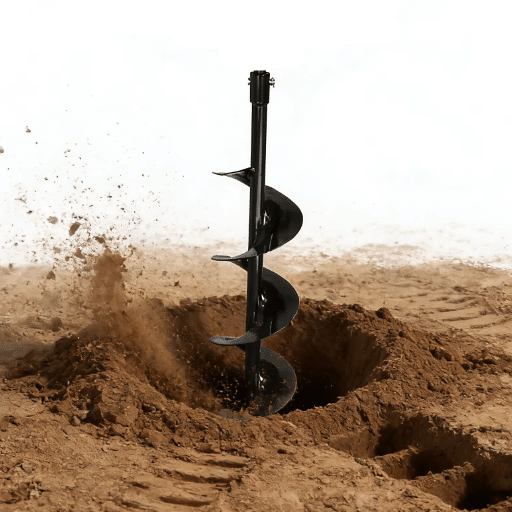
Choosing the wrong auger for your soil type is the fastest way to destroy efficiency. The table below maps Unified Soil Classification System (USCS) categories to the recommended auger type, RPM, torque, and expected performance.
| Soil Type (USCS) | Best Auger Type | RPM Range | Torque (kN\u00b7m) | Expected Advance Rate | Key Considerations |
|---|---|---|---|---|---|
| CL / CH (Clay) | Solid stem or hollow stem | 15-25 | 30-80 | 3m/hr | Watch for clay balling; consider water injection |
| ML / MH (Silt) | Solid stem | 20-35 | 20-50 | 4 m/hr | Potential for quick conditions; monitor groundwater |
| SP / SW (Sand) | Hollow stem preferred | 25-40 | 15-40 | 5 m/hr | Risk of collapse below water table; casing essential |
| GP / GW (Gravel) | Hollow stem or bucket | 15-25 | 40-100 | 1 m/hr | High wear on teeth and flights; expect cobble refusal |
| OL / OH (Organic) | Hollow stem | 10-20 | 20-40 | 2 m/hr | High compressibility; low shear strength |
| SC / SM (Clayey/silty sand) | Hollow stem | 20-30 | 25-60 | 3 m/hr | Mixed behavior; adapt RPM to dominant fraction |
Clay-Specific Guidance
Stiff to hard clays demand high torque and low RPM. The cutting edge must slice cleanly rather than smear. If the clay is plastic, the risk of balling increases dramatically. In those conditions, hollow stem augers with water injection ports or modified flight pitch can keep the tool clean.
Sand-Specific Guidance
Loose sand drills fast but offers no natural support. Below the groundwater table, sand can flow into the borehole as soon as the auger is withdrawn. Hollow stem augers solve this by leaving the casing in place during sampling. Reduce withdrawal speed to minimize suction and disturbance.
Equipment Specifications and Rig Selection
Rig selection for soil auger drilling depends on the maximum torque you need to break the soil shear strength and the depth you must reach. The following table connects rig class to realistic soil drilling capability.
| Rig Class | Max Torque | Max Depth (Soil) | Typical Diameter | Best Application |
|---|---|---|---|---|
| Small portable | 5-15 kN/m | 10 m | 100-200 mm | Handheld replacement; geotechnical probing |
| Mid-size tracked | 50-120 kN/m | 20 m | 300-800 mm | General geotechnical; environmental drilling |
| Large CFA rig | 150-300 kN/m | 30 m | 600-1,200 mm | Foundation piling; urban construction |
| Heavy-duty rotary | 200-500 kN/m | 40 m | 800-2,000 mm | Mixed soil and rock; deep shafts |
Kelly bar selection matters just as much as rig power. In soil, friction kelly bars are usually sufficient because the auger does not need to transmit the extreme percussion or pull forces required in rock. Make sure your kelly box sizes match the rig drive and auger connection.
Soil Sampling and SPT with Hollow Stem Augers
Hollow stem augers are the platform of choice for Standard Penetration Testing (SPT) in soils. The workflow is straightforward but demands precision:
- Drill to the target depth with the hollow stem auger in place.
- Remove the center plug from the auger head.
- Lower the split-spoon sampler through the hollow center.
- Drive the sampler with a 63.5 kg hammer falling 760 mm.
- Record the blow count for the last 300 mm of penetration (N-value).
- Withdraw the sampler, seal the sample, and log the soil.
- Replace the center plug and continue drilling.
The auger flights keep the borehole open and stable during the entire process. This eliminates the need for drilling mud or casing in most soil conditions above the water table.
Elena, a geotechnical engineer working near the Vistula River in Poland, learned this workflow the hard way. Her crew was running solid stem augers for SPT in loose sand. At 4.5 meters, they hit the water table. The borehole collapsed before they could drive the split spoon. They switched to hollow stem augers the next day. The casing effect of the hollow stem kept the sand stable, and they completed the full 20-meter profile without a single collapse. The additional rental cost of the hollow stem system was recovered on the first day of saved time.
Common Problems and Troubleshooting

Clay Clogging and Balling
Symptoms: Torque rises, advance rate drops to near zero, auger withdraws with clay packed solidly around the stem.
Causes: High-plasticity clay adheres to the flight surface. Low RPM and insufficient clearance between flights make it worse.
Fixes:
- Increase RPM slightly to throw cuttings outward by centrifugal force.
- Inject water or drilling fluid to reduce adhesion.
- Switch to a flight pitch that is slightly larger relative to diameter.
- Use hollow stem augers with center flushing if available.
Sand Collapse Below Water Table
Symptoms: Borehole fills with sand during auger withdrawal, samples are contaminated, depth logging becomes unreliable.
Causes: Hydrostatic pressure and loose grain structure cause the sand to flow inward once auger support is removed.
Fixes:
- Use hollow stem augers and leave the string in place during sampling.
- Reduce withdrawal speed to minimize suction.
- Maintain a positive head of water inside the borehole if permitted.
- Switch to rotary mud drilling if collapse is persistent.
Excessive Torque in Dense Soils
Symptoms: Rig torque gauge approaches maximum, engine load increases, penetration stalls.
Causes: Dense sand, gravel, or cemented soil exceeds the auger’s cutting capacity.
Fixes:
- Reduce RPM and increase crowd force to let the cutting edge work.
- Inspect cutting edges for wear; dull teeth increase torque demand.
- If refusal continues, transition to a heavy-duty auger or a bucket tool.
Sample Disturbance and Depth Uncertainty
Samples retrieved from auger flights are disturbed by definition. The mixing of strata during transport means you cannot assign an exact depth to a specific handful of spoil. For accurate stratigraphic logging, rely on split-spoon samples through hollow stem systems or switch to undisturbed thin-wall tube sampling where required.
Cost and Efficiency by Soil Type
Penetration rate and tool wear vary dramatically across soil classes. The table below gives realistic field benchmarks for mid-size rigs with standard tooling.
| Soil Type | Penetration Rate (m/hr) | Tool Wear Index | Relative Cost per Meter | Typical Cutter Change Interval |
|---|---|---|---|---|
| Soft clay | 6-12 | Low | Low | 200-300 m |
| Stiff clay | 3-8 | Low to Moderate | Low | 150-250 m |
| Loose sand | 8-15 | Moderate | Low to Moderate | 100-200 m |
| Dense sand | 4-8 | Moderate | Moderate | 80-150 m |
| Gravel | 1-3 | High | Moderate to High | 30-80 m |
| Organic soil | 2-5 | Moderate | Moderate | 100-180 m |
Gravel is the outlier. Cobbles and boulders damage cutting edges, dent flight surfaces, and cause frequent refusal. If your geotechnical report shows more than 20 percent gravel content, budget for shorter cutter life and consider whether a drilling bucket or core barrel would be more economical overall.
When to Switch from Soil Auger to Rock Tool or Bucket

Soil augers have a clear operational ceiling. Continuing to push in material beyond that ceiling wastes fuel, wears teeth, and risks tool damage. Use these transition triggers:
| Indicator | Threshold | Recommended Next Tool |
|---|---|---|
| SPT N-value | 50 blows per 300 mm | Rock auger or core barrel |
| Visible rock fragments | Continuous chips in cuttings | Rock auger |
| Torque spike | 30% above baseline for soil type | Inspect; switch to rock tool |
| Advance rate | 0.5 m/hr despite full power | Core barrel or drilling bucket |
| Refusal | Auger will not penetrate after adjustment | Core barrel or rock auger |
The decision matrix is simple in concept but nuanced in practice. Stiff clay at SPT N = 60 may still be drillable with a high-torque soil auger, while weathered rock at N = 40 will destroy standard soil cutting edges in minutes. Examine the cuttings. If you see angular rock fragments rather than rounded soil particles, it is time to switch.
For guidance on rock-specific tooling, see our rock auger drilling guide.
Jin, a project manager on a high-rise project in Ho Chi Minh City, monitored this transition daily. His CFA rigs were working through 18 meters of soft clay and silt. At 19 meters, the torque climbed 35 percent and the penetration rate dropped from 8 m/hr to under 1 m/hr. The cuttings changed from smooth clay ribbons to gritty, angular fragments. Jin stopped the auger, switched to a rock auger with conical bullet teeth, and finished the socket into the weathered sandstone. The decision saved an estimated six hours of stalled drilling and prevented damage to the CFA flight that would have cost far more in replacement.
FAQ: Soil Auger Drilling
What is the maximum depth for soil auger drilling?
For solid stem augers in favorable cohesive soils, 20 to 30 meters is typical. Hollow stem systems can reach 45 meters. CFA piling rigs routinely drill to 50 meters.
Can soil augers drill below the groundwater table?
Yes, but with limitations. Hollow stem augers act as temporary casing and are the best choice for saturated sands. Once the auger is withdrawn, loose saturated soils may collapse unless a casing is left in place.
How do I choose between solid stem and hollow stem augers?
Use solid stem for fast, low-cost geotechnical work in dry cohesive soils. Use hollow stem when you need undisturbed samples, SPT testing, or groundwater monitoring.
What RPM should I use for clay soil?
Stiff clays work best at 15 to 25 RPM with high torque. Soft clays can tolerate slightly higher RPM, but excessive speed increases the risk of clay balling.
Why does my auger clog in clay?
High-plasticity clay adheres to steel surfaces. Solutions include increasing flight pitch, adding water injection, raising RPM modestly, or switching to a hollow stem with center flushing.
Is CFA piling the same as soil auger drilling?
CFA uses a continuous flight auger, which is a type of soil auger. The key difference is that CFA is a foundation construction method where concrete is pumped through the hollow stem during withdrawal to form a pile.
Conclusion
Soil auger drilling is not a one-size-fits-all operation. The difference between a productive day and a stalled rig often comes down to matching the auger type to the soil behavior in front of you. Solid stem augers cut fast and cheaply in dry clay. Hollow stem augers protect the borehole and enable quality sampling in loose sand. CFA systems turn soft ground into deep foundations with minimal vibration. Bucket augers move large volumes in shallow holes.
The contractors who win are the ones who read the geotechnical report before choosing the tool, who watch the torque gauge and the cuttings as closely as the depth meter, and who know when to stop pushing a soil auger into ground that has become something harder.
If you are planning a project and need augers matched to your soil conditions, Changsha Mingyi Machinery Equipment Co., Ltd. designs and manufactures soil augers, hollow stem systems, and CFA tools for foundation contractors worldwide. Contact our engineering team for a specification review.