The auger is an efficient and precise tool used in the construction and earthmoving industries, and very few tools can be compared with it. The concept of the spiral drill hole has its roots with Archimedes, however, the powerful modern auger has become an essential tool for the agricultural, industrial and construction sectors when it comes to earth excavation. In the case of professionals who need to install fences, drill foundations, or take soil samples, the awareness of the technical details of such systems is necessary for the success of their operations.
This guide is a detailed overview of the dirt auger’s mechanical workings, collection of applications, and methods of operation. Through the analysis which corresponds to hydraulic specs, soil mechanics, and bit configurations, the operators will be able to blend factors in order to achieve maintenance of the equipment and project efficiently now and in the future.
Understanding the Auger System

What is an Auger?
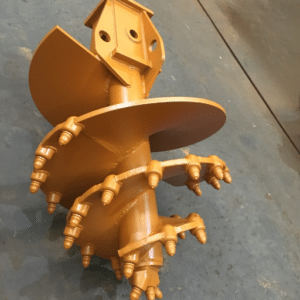
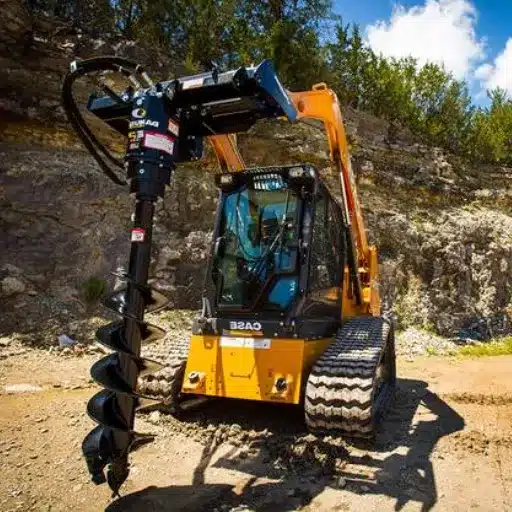
An Auger is a device that is used for drilling purposes. The bit for drilling, that usually has a rotating helical screw blade named “flighting” is considered, acts as a screw conveyor and thus removes the material that has been drilled out. The turning movement of the bit pushes the material out of the hole that is being drilled. Heavy machinery will usually have a hydraulic or PTO-powered auger for dirt, which will be a skid steer, excavator, tractor or backhoe attachment. The capability of the machine greatly depends on the “pitch” of the flights—the space between the points that form the spiral and that of the next winding.
The Parts of the Dirt Auger
A top-quality dirt hole digger is made up of many different parts, each with demanding conditions of cutting and wear:
The Drive Unit: The drive unit is the motor ensemble that usually includes hydraulic or planetary gear reduction for imparting torque. This unit needs to match the hydraulic flow (Gallons Per Minute or GPM) and pressure (PSI) capacities of the carrier machine.
The Shaft: It is the central tube to which flighting is adhered. In the case of heavy-duty applications, the need for resistance to torsion and bending would lead to using a thick-walled tubing.
The Flighting: It is the spiral metal blade through which the soil is carried. The returned wear life is altered by the thickness of the flighting; the edges can be subjected to “hard-facing” welding to extend life in abrasive situations.
The Cutting Head: It is the assembly that houses the teeth and is attached to the bottom of the auger.
Teeth and Pilots: The “teeth” refer to the cutting edges in the periphery of the head, and the “pilot” bit is the center point that gives stability to the auger and initiates the fracturing process. These are replaceable parts and are very important for the rates of penetration.
Types of Auger Bits and Specifications
Auger bits are all different; the shape of the bit is related to the land condition of the work site.
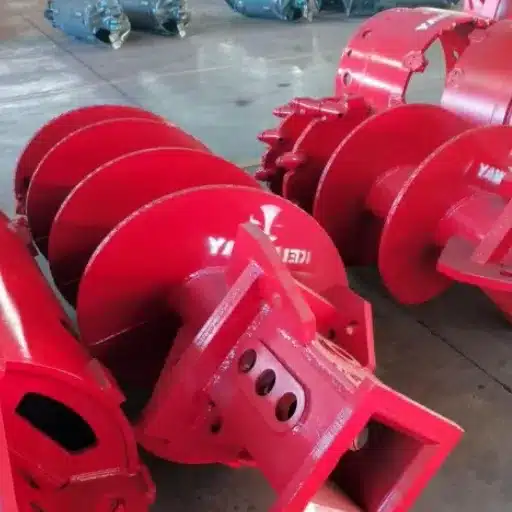
Standard Earth Bits: They are favorable for loosened and fracturable soils. Some of their main features are bolt-on teeth and a fishtail pilot. They are less expensive to use, but they are not a good choice for compacted soil.
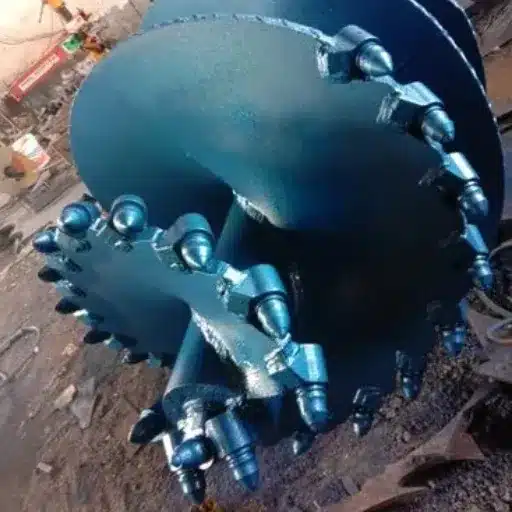
Heavy-Duty Bits: They are best for used with stiff clay, hard soil, and the old asphalt. They are built to be equipped with rotating tungsten carbide (TC) rock bits, which are highly efficient in breaking and cutting but not in scooping materials.
Rock Augers: These bits are specifically designed to drill through rocks and concrete. They are made with strong flighting and carbide teeth that look like flat bullets but unlike the latter are specially positioned at high angles for chipping the rocks. The bits need a lot of pressure and torque and therefore require fewer revolutions per minute (RPM) than the average earth bit.
Applications of Augers in Various Industries
Agricultural Uses of Dirt Augers
In modern agriculture, the auger is indispensable for infrastructure maintenance and crop management.
Fencing Operations: One of the most prevalent agricultural uses is to drill holes in the ground to erect the fence posts. The operations of the fence planting and property fencing are mainly done by a single person using the tractor-powered PTO auger who would be able to drill a few hundred holes every day. This would not be possible at all if one were to do it manually.
Orchards and Forests Planting: Along with farming, the most common application of auger has been among the orchard and forest planters. For the tree planter, first, the hole is normally made using the regular auger. The tree wire cage is lowered into the hole and filled with potting mix ready for the tree. At the tree planting site the hole is pre-drilled which will enable a quick and easy pull into the upper soil layer once the tree is planted into the container.
Additionally, the auger through which the drill bit passes has a larger diameter than the diameter of the bit, so the auger is going to scrape the wall metal off the drill bit every time the drill bit has gone through one complete revolution. This leads to higher wear and tear of the drill bit and lower efficiency of drilling.
Orchard and Forestry Planting: For tree planting, specific tree-planting augers are used. These feature a tapered design (smaller diameter at the bottom, larger at the top) or a specific flight pitch to leave loose soil at the bottom of the hole, encouraging root growth. Using a standard dirt auger in wet clay can cause “glazing” of the hole walls, which creates a pot-like barrier that roots cannot penetrate. Specialized agricultural augers are designed to roughen the sidewalls to prevent this.
Soil Sampling: Precision augers, among the tubes, are commonly used for collecting core samples that will be later analyzed for nutrients. The nutrient analysis is a significant factor in the natural agricultural cycle where proper fertilization and crop rotation are crucial.
Industrial Applications of Hole Diggers
Apart from the farms, the augers are also very useful in the heavy industries and extraction of resources.
Geotechnical Drilling: Soil testing has to be carried out before the construction of a big building. It is a norm to employ a hollow-stem auger to get deep into the ground, allowing soil sampling, and to install the groundwater monitoring wells. This would involve the use of very accurate instruments that can go to very deep levels without causing the borehole to collapse.
Utility Installation: The utility poles and transmission towers have to be firmly and deeply rooted for the strong winds, so the holes for their foundations have to be very wide and deep. The correspondingly oversized holes are dug by industrial augers carried on rotary drill rig cranes that are used to power the bores in different earth layers to site the critical infrastructure items.
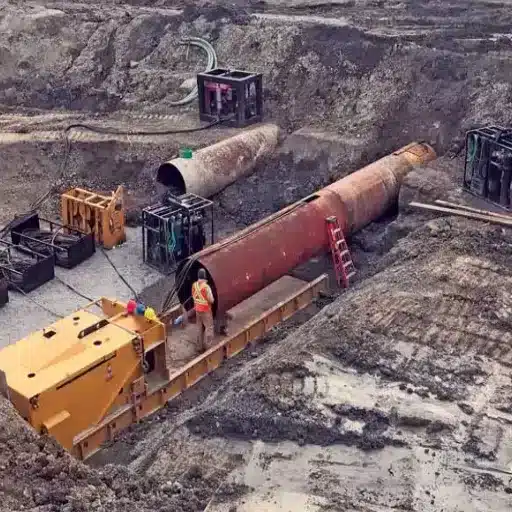
Mining: Highwall mining is a method that involves the use of augers that can reach very far distances to perform horizontal drilling in order to extract coal or minerals from seams that were revealed by the highwall, the latter being one of the significant results of open-pit mining.
Construction and Landscaping Focus on Dirt Hole Augers
In construction, the dirt hole auger is most likely the first tool to go down to the earth.
Foundation Pilings: Augers are used to drill shafts for the decks, pole barns, and pier and beam foundations. The importance of hole diameter and verticality accuracy cannot be underestimated in the construction of a structurally sound building.
Retaining Walls: Soldier pile walls consist of vertical H-piles that are placed in pre-drilled holes. Augers that can work through different types of soil and rock are crucial for these types of soil-retention systems.
Landscaping architecture: For planting mature trees in large-scale landscaping projects, the most common equipment used is the augers. Unlike saplings in the agriculture sector, mature trees with the root ball intact need to be planted by excavating a wide diameter hole (30 to 48 inches). The torque output provided by the hydraulic of skid steer allows the auger to turn the bit of that size.
Choosing the Right Auger for Your Needs
Critical Aspects for Choosing an Auger
First of all, the hydraulic flow and pressure of the host machine are by far the most important factor when selecting an auger.
Flow (GPM): The GPM value of hydraulic fluid identifies how fast the auger will rotate. If this value is too low, the drilling process will be slow; if it is too high, the pressure can harm the motor seals.
Pressure (PSI): The PSI value of the hydraulic system plays an important role in both motor’s torque and the drilling power. High PSI is required in case of drilling through hardpan, frost or rock.
Attachment System: The place where the drive unit joins with the machine (e.g., universal skid steer plate, excavator pin-grabber) has to provide looseness that is enough. A “knuckle” joint prevents the auger from being inclined on uneven ground.
Natural Conditions: It’s very important for drivers to assess how harsh the ground is. For instance, the soil comprising lots of angular and sharp silica minerals can quickly wear down the standard steel auger flights and thus, the operators will have to go for augers equipped with tough-face material or may even need to use the carbide variant.
Table of Various Auger Diameters
Auger bits are known for being sorted by the diameter size and the length size. It is common to use 4-foot-long standard ones, but in case you need to go deeper, extra fittings of the drill can be placed.
4-inch to 9-inch: These diameter bit sizes are suitable for carrying out the task of fencing construction and small deck footing. It’s better to use tractors with lower power and torque to finally run them. One can even work with the mini-skid steers.
12-inch to 18-inch: These diameter bit sizes are the best choice for digging the ground for foundation usage, making the biggest corner posts one can ever see, and also for simple tree planting. Standard skid steer or excavators of medium size are required for this.
24-inch to 36-inch: The planting of large trees and pier foundation drilling call for the bit sizes of 24-inch to 36-inch. Powerful drives are needed in this case (often planetary drives, not direct drives) to keep the bit rotating even as the hole is being formed.
Tips for Effective Use of a Dirt Hole Digger
You will find that the way you are handling the machine is the most important factor that affects the speed at which you are drilling.
The pressure acting on the downhole area should be handled with care: A very common mistake is to exert too much force on it (jostling). This might subsequently make the machine drive the drill head into the soil in a spiral manner until it fully stalls. Here the aim is to let the bits do the cutting and the flighting, lifting.
Clear Out Spill: That is, to drill down just several feet, and then to raise the auger (but without running it backward) to get rid of the spoil from the hole. When the auger is run backward, the spoil is pushed back into the hole.
Vertical Alignment: Get the auger plumb first. Most of the modern adaptations will allow the auger to swing freely to find the vertical position but the operator must verify the alignment, via sight, in order to avoid crooked holes.
Maintenance and Safety Tips for Auger Users
Auger Care and Maintenance Guidelines
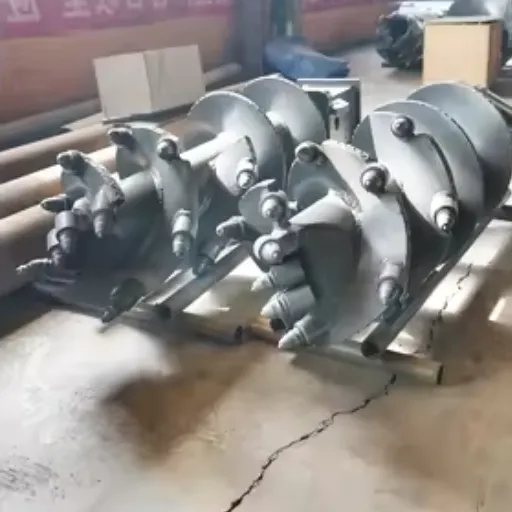
Tooth Inspection: The working edges of the teeth along with the pilot bit are areas that get most of the wear. The auger will tend to drift off its course and finally stop being able to penetrate if the tip of the pilot wears off to a circular stub. The carbide edge of teeth should be checked every day and then either turned around or changed out the moment it is damaged.
Wear Inspection: The edges of the flighting should be checked for wear. When the flighting becomes smaller, then the effective diameter of the auger is reduced at the same time. The post intended for a certain size or the footing may not fit the hole which is too small according to the aforementioned dimensions.
Lubrication: The output shaft together with the universal joint (if any) should be properly greased at the regular intervals to avoid metal-on-metal seizure.
Hydraulic Integrity: Where hoses and couplers are concerned, regular checks should be made for leaks. A drop in hydraulic pressure basically points to a leak, which could mean a dramatic reduction in torque.
Safety Procedures for Augers Use
One major safety concern that comes with the use of augers is the risk of being caught in. Following safety procedures is a must.
Call Before You Dig: It is mandatory that you make a call to 811 in the USA to get rebar utility lines marked prior to any type of excavation activity. A metal auger is a great conductor of electricity and therefore could be very dangerous if it came in contact with a gas line or electrical cable.
Exclusion Zones: There should not be any people within a 10-feet radius of the rotating auger. Both gear and length of flow installation, personnel on site budget, we provide air conditioning.
If clothing/jumping rope is caught in the spinning shaft or flighting, that is operator casualty. Torque Hazards: For one-man or two-man augers with accessory chucks (such as double-ended hand drills), torque transfer is a significant risk. Should the bit hit a stone; therefore, the worker operates in a hazardous situation where it is quite possible for him/her to be thrown and also sustain broken wrists. Nobody is allowed to act out of a braced position and, where it is practical, torque-limiting clutches must be fitted to the units.
Common Issues and Troubleshooting Tips
Auger Corkscrewing: If the drill screws into the ground and gets jammed-in area, do not try to pull it out with the machine’s boom lift capacity only Due to its capacity, the latter may damage the boom. Instead, reverse the rotation while gradually lifting.
Failure to Cut Through: When the auger rotates but does not cut, we can assume that the ground is too hard for the teeth or the teeth are no longer sharp. It is recommended to change the teeth with carbide bullet teeth or increase the downforce on the machine (if allowed).
Clay wrapping: If the trench wall has a clay-like coating and the side cutting teeth are worn, it is probable that the teeth failure caused it as the most common reason for the issue. Installing gauge teeth (teeth that have a slightly larger diameter than the flighting) should help to roughen the surface of the trench walls.
The Future of Auger Technology in Excavation
Innovations in Auger Design and Functionality
Metallurgical advancements that are taking place presently are being reflected onto the flighting materials, which in turn, make them lighter and stronger so that they can be less of a load on the carrier machine withstanding abrasion as well. Additionally, variable-pitch augers, which the spacing of the flights is changed according to their position on the shaft, are under development. This leads to a tighter pitch, and thus torque, at the bottom, and a wider pitch at the top and, hence, speed.
Environmental Impact and Sustainable Practices
Drilling with an auger is a less invasive process compared to excavating with a bucket. With auger drilling, only the necessary amount of soil is removed, which consequently leads to a reduction in the amount of backfill required and, at the same time, a very limited effect on the neighboring ecosystem. The method puts forward the use of the latest technologies and sustainable construction methods [which are time tested and comply with the current market standards of environmental concerns] in this “surgical” way of excavation, especially so in the case of wetlands or urban areas that are being well taken care of.
The Role of Automation in Auger Systems
Auger jobs are now becoming more profitable because they are combining GPS and telematics systems. New drilling rigs can be set up with the exact depth and location coordinates. The machine, even without an operator, can automatically stop drilling to make sure that all pilings will have the same depth and the foundation will be optimal. Moreover, hybrid labor systems are replacing conventional excavation ones by using remotely operated machines eliminating any danger and cutting down on operators’ exposure to hard work while they are controlling the machinery from a safer location.
Reference Sources
-
Soil Sampling & Tools – Oklahoma State University – Provides insights into tools like augers for soil sampling and their practical applications.
-
A Field Guide to Soil Sampling – Michigan State University – Explains the use of augers and soil probes for effective soil sampling techniques.
-
Advantages and Disadvantages of Auger, Rotary, etc. – Penn State University – Discusses the pros and cons of augers in different soil conditions and applications.
Frequently Asked Questions (FAQs)
Which size and type should I choose for my soil?
To use a dirt auger safely and efficiently, select the auger, drill diameter and length, and tooth design, that are most suited to your soil and project needs. One example is a 4″ dirt auger that is perfect for bulb planting while a much larger 48″ or even wider diameter auger will be excellent for post holes. The cordless power planter option and the power drill or the hammer drill attachment power the drilling process even faster, and are a good alternative for a battery-operated unit. The steel shafts and wear protection of wear parts will enhance the machine for a clay and other hard grounds while the small design will be excellent for the loose and light ground. To have the ability to use the product for many posts and heavy labor, select the one equipped with a shank that can handle the demand as well as an extension in that product series. Always ensure the compatibility of the chuck with your power drill or the power planter system.
How do I use a dirt auger safely and efficiently?
You might start with the ideal tool and make sure that the power source — either cordless battery or a power drill plugged in — can handle the torque of the auger bit and shaft length. A slow, steady feed prevents the auger bit from becoming stuck in very dense ground or rocks; and hold the auger handle or lever, or handle grip is the balance factor. When it comes to a hard soil or clay, a two-piece drill shank is more suitable because it protects the drill and makes it more rigid, and so selects the drill according to the hardness of the soil if possible. Never allow the drill to go down on packed dirt, clay, or stones without building a soft mound. Digging in wet ground and in the area in which the hole is being dug are conditions for which it should not be used. If the drill is not kept clean and the steel is not lubricated when in use, the hole will eventually become a loose fit in the ground where it has been in operation. Buildings, roads, and other installations with infrastructure that could be damaged due to the installation of close-filled holes should be protected with other methods of installation.
What maintenance is necessary for dirt hole augers?”
To keep auger strong and durable for heavy use, it is a must to inspect regularly the wear parts like teeth and shank for damage as well as to replace them when the performance is beginning to deteriorate. After every operation, you must also remove the dirt and clay from the spiral and the shaft to avoid the steel from rusting and to retain the quality of the steel and chucks. Besides, lubricate the moving joints and make sure that the extensions and collars are fitting tightly to avoid wobbling that may trap or damage the bit. The product must be placed in a dry area and it is advisable to bring with you a set of spare teeth or even an extra bit if you expect the ground to be hard or the demand to be high. Taking care of the auger in this way lessens the chance of breakage and maintains its efficiency for several years.
Can a cordless drill be used with an auger to dig holes?
A power drill that accepts smaller auger bits may be handy for light tasks but is very powerful at the same time, especially when a dirt auger compatible with drills and the chuck is used. The dedicated power planter or the motorized auger then become necessary for a higher level of activity or wider diameters because it is easier to control, has a higher torque, and has a faster cycle. Then, the power rating of the drill needs to be checked since an underpowered drill may totally blow in heavier soil, while the shank and chuck should be securely fitting; an underpowered drill may stall or trap the auger in tougher soil. Battery drills are easily transportable and very useful for outdoor garden work, and battery life and swap-in batteries are very important in case of extended projects. Besides using a cordless drill for easier work, you should use one that is right for the job. In order to get good and fast results in different kinds of soil, it is advisable to adjust the power of the tool to the auger specification.
How can the hole be digged through the heavy soil like clay using the auger?
If the soil is harder, it is better to use an auger that has a reinforced steel shank, aggressively toothed, and may be operated with a hammer. It is also a good idea to consider an auger that has a wide bit or a trapline tooth design to sum up and explain the solution clearly. Wetting down the very hard clay might be an option so the digging is faster and easier on the machine. If this is not enough and the soil is very densely packed, then it might be the case that the hole is merely too deep and one should first check that. A stricter rule of thumb is, from that point onward, to consider utilizing a powered system instead of a hand-operated one. A high-torque power drill may be considered in a situation that is less serious as the last resort. It is only desirable to continue the work under the feeling of total control to ensure that the machine will not get stuck. To avoid getting stalled under load, the presence of powered solutions might be the way of the future. It is also important that the replacing of the other parts besides the teeth is accurately paid attention to.
What are the most important aspects to consider when selecting a dirt auger for your needs?
Core details include the size of the hole (in inches), the overall length (such as 48″ options), the formation of the shaft and shank (quality of steel), and the kind of teeth that you anticipate using for the soil. Please ensure your drill or power planter system is compatible and that there are extensions and quick-release chucks available to suit different projects. Find out about weight and portability if you are in need of a small, handy garden tool, which may be the case if you do outdoor or garden work. The drill drill and does well in given soft ground, but it struggles in clay and very loose soil. This is one of the most effective and dependable methods to make holes every time that you want them.