Rotary drilling is the backbone of modern extraction and exploration industries, spurring increased efficiency, precision, and safety. By working with this fundamental drilling method, industries like oil and gas, mining, and geothermal energy have completely redesigned how they tap resources found deep beneath the Earth’s surface. This comprehensive guide explores the working principles behind rotary drilling, examines the latest technological developments, and provides insights into the innovative practices reshaping the industry today.
Overview of Rotary Drilling
What is Rotary Drilling?
Rotary drilling is a method for drilling boreholes with applications for extracting oil, gas, and minerals. It rotates a drill bit to cut down into underground formations while drilling fluid circulates through the drill pipe to carry cuttings away and pressurize the annulus for wellbore stabilization.
This technique is preferred for its:
- Performance Excellence: High efficiency in various geological conditions
- Flexibility: Adaptable to different formation types
- Depth Capability: Ability to drill to extreme depths
- Precision Requirements: Essential for resource exploration and development
Importance of Rotary Drilling in Modern Operations
Industry Impact: Recent data shows steady growth in demand for rotary drilling systems as industries focus on sustainable practices and accurate resource monitoring.
Rotary drilling is essential for modern resource extraction and infrastructure development due to its efficiency and versatility. The technique enables operators to penetrate various geological formations with precision and minimal environmental impact.
Key Applications
- Oil and Gas Industry: Primary method for hydrocarbon extraction
- Water Wells: Essential for accessing groundwater resources
- Geothermal Energy: Critical for geothermal power development
- Mining Operations: Used for mineral exploration and extraction
Comparison with Other Drilling Methods

| Method | Speed | Efficiency | Automation Level | Environmental Impact |
|---|---|---|---|---|
| Rotary Drilling | High | Excellent | Highly Automated | Low |
| Cable Tool Drilling | Low | Limited | Manual | Moderate |
| Percussion Drilling | Moderate | Good | Semi-Automated | Moderate |
Components of the Rotary Drilling System
Drill String
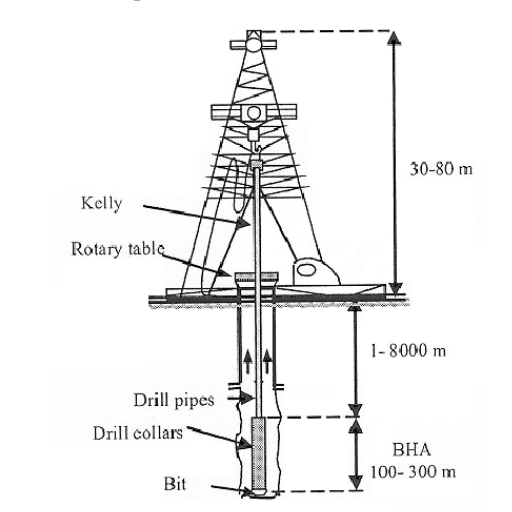
Assembly of connected drill pipes used to transmit torque from the rotary table to the drill bit, allowing circulation of drilling fluid.
Rotary Table or Top Drive
Supplies the rotation needed to drive the drill bit through rock formations.
Drill Bit
Located at the end of the drill string, performs the actual cutting or grinding of rock to create the borehole.
Mud Circulation System
Pumps drilling fluid down through the drill string and back up through the annulus, cooling the bit and removing cuttings.
Blowout Preventer
Primary safety device installed on the wellhead to control pressure surges and prevent uncontrolled fluid escape.
Drill Bit Types and Selection
| Bit Type | Material | Best Applications | Key Advantages |
|---|---|---|---|
| PDC Bits | Polycrystalline Diamond Compact | Hard formations, oil & gas | Exceptional hardness, deep drilling capability |
| Roller Cone Bits | Steel with cutting teeth | Various geological conditions | Versatile, rotating cones adapt to formations |
| Fixed Cutter Bits | Tungsten carbide or diamond | Softer formations | Higher penetration rates in suitable conditions |
Types of Rotary Drilling Methods

Uses clockwise drill bit rotation with downward pressure applied against the formation. Drilling fluids circulate to lubricate the bit and carry cuttings to the surface. Most suitable for soft to medium formations.
Widely used in mineral exploration with dual drill pipes. Compressed air flows down the annular space while cuttings travel upward through the center tube, ensuring sample efficiency and purity.
Advanced method allowing drillers to steer the bit toward non-vertical targets. Essential for horizontal drilling in oil and gas operations, minimizing surface disruption.
Uses compressed air instead of liquid for debris removal and bit cooling. Preferred in harder formations and arid environments where water is scarce.
Ideal for softer soil and clay-like conditions. Uses water-based or synthetic drilling fluids to stabilize the borehole and transport cuttings to the surface.
Air Rotary Drilling
Technical Specifications
- Depth Range: 200-1,200 feet (depending on field conditions)
- Formation Types: Hard geological formations, rock, consolidated materials
- Technology: High-velocity compressed air for cutting evacuation
- Modern Features: Twin rotary capability with DTH hammers
Advantages of Air Rotary Drilling
- Water Conservation: Ideal for arid and semi-arid regions
- Environmental Protection: Minimal environmental damage
- Performance Monitoring: Advanced sensors for borehole integrity
- Versatility: Suitable for geothermal, environmental, and water well projects
Mud Rotary Drilling
Mud rotary drilling excels in soft and medium formations such as clay, sand, or shale. The continuous circulation of drilling fluid (“mud”) serves multiple critical functions:
- Borehole Stabilization: Maintains wall integrity
- Bit Cooling and Lubrication: Extends equipment life
- Cutting Transport: Efficiently removes debris to surface
- Pressure Control: Manages formation pressures
Drilling Capacity: Modern mud rotary systems can reach depths of 10,000+ feet, supporting various applications from oil and gas to environmental monitoring projects.
Mud Additives and Customization
| Additive Type | Primary Function | Common Materials |
|---|---|---|
| Density Control | Increase mud weight | Barite, Hematite |
| Viscosity Modification | Control flow properties | Bentonite clay, Polymers |
| Filtration Control | Reduce fluid loss | Starch, Cellulose |
Dual Rotary Drilling Techniques

Advanced Dual-System Technology
Dual rotary drilling represents a significant advancement in drilling technology, employing two independent driving systems – one for the casing and another for the drill string.
Key Benefits:
- Simultaneous Operations: Drill and advance casing concurrently
- Hole Stability: Prevents collapse in unstable formations
- Reduced Vibration: Minimizes equipment stress and contamination risk
- Environmental Compliance: Meets strict environmental standards
Drilling Operations and Efficiency
Best Practices for Modern Operations
- Real-Time Data Integration: Implement monitoring systems for precise decision-making
- Environmental Optimization: Use biodegradable fluids and minimize site disturbance
- Predictive Analytics: Employ AI models for geological data analysis
- Risk Mitigation: Utilize advanced control systems for safety enhancement
- Resource Management: Optimize fuel consumption and material usage
Innovations in Rotary Drill Rigs
Cutting-Edge Technologies
Hybrid Power Systems
Modern rigs incorporate hybrid technologies to minimize fuel consumption and reduce emissions, aligning with global environmental standards.
Automation and AI Integration
- Sensor Systems: Real-time operational adjustments
- Machine Learning: Predictive maintenance and issue prevention
- Data Analytics: Historical and real-time geological analysis
- Remote Monitoring: Enhanced safety and operational efficiency
Challenges and Solutions in Rotary Drilling
| Challenge | Impact | Modern Solution |
|---|---|---|
| Unpredictable Formations | Delays, equipment damage | Advanced geological analytics and pattern recognition |
| Equipment Downtime | High operational costs | Predictive maintenance using machine learning |
| Drill Bit Wear | Reduced efficiency | Real-time monitoring and automated bit selection |
| Pressure Management | Safety risks | Advanced pressure control systems |
Future Trends in Rotary Drilling

Emerging Technologies Shaping the Industry
AI and Machine Learning Integration
- Predictive algorithms for equipment failure prevention
- Optimized drill path planning
- Enhanced operational efficiency through data analysis
Sustainability Focus
- Low-emission drilling machinery
- Advanced waste management systems
- Renewable energy integration
Smart Drilling Systems
- IoT sensors for real-time monitoring
- Cloud-based analytics platforms
- Automated decision-making capabilities
Sustainability in Drilling Operations
Modern drilling operations increasingly emphasize environmental responsibility through innovative technologies and practices:
- Resource Optimization: Maximizing efficiency while minimizing waste
- Emission Reduction: Implementing clean energy solutions
- Data-Driven Solutions: Using analytics to reduce environmental impact
- Renewable Integration: Incorporating sustainable energy sources
References
-
Types of Drilling Rigs – Missouri University of Science and Technology
A PDF document explaining various drilling methods, including mud rotary drilling, and their applications.
Visit the site -
Development of a Low-Cost Rotary-Steerable Drilling System – NETL
A report from the National Energy Technology Laboratory (NETL) on the development of a rotary-steerable drilling system.
Visit the site
Frequently Asked Questions (FAQ)
What is a rotary drilling system?
The rotary drilling system constitutes a drilling method that utilizes a drill bit that rotates. The system serves to move the drill bit into the earth as efficiently as possible while circulating drilling mud inside the drill to cool the bit and carry away cuttings. Some components under the rotary system include the rotary table and kelly, drill collars, and drill rods, all of which must operate in concert for an efficient drilling activity.
How do drill collars operate in the rotary drilling process?
These are heavy, thick-walled tubes added to the drill string to provide weight and stability to the drill bit. They help ensure that the rotation of the drill bit is necessary and can assist in going deeper into the ground. Thus, the weight of the drill pipe with which the drill collars are used applies the necessary force to the drill string to enable efficient drilling in different applications.
What are the advantages associated with top drive systems in rotary drill rigs?
There were some advantages of the top drive system over the conventional rotary table. It allowed for faster drilling operations by rotating the drill string directly instead of the rotary table and kelly drive. This system can also reduce the time spent making connections, therefore increasing the probable time available for actual drilling operations.
How does the circulation of drilling mud take place in a rotary drilling system?
The drilling mud circulation is vital in rotary drilling since it cools the spinning drill bit while transporting cuttings up to the surface. The mud is pumped down through the drill string and enters the space between the drill and the borehole, returning it to the surface through the annulus. This maintains pressure and stability within the wellbore and also ensures an efficient drilling operation.
What is the major difference between air rotary drilling and mud rotary drilling?
Air rotary drilling uses compressed air for removing cuttings and cooling the drill bit, suitable for soft formation and less water-sensitive environment. Mud rotary drilling uses drilling mud to do the same functions and is better at stabilizing the borehole in adverse conditions. Each method is chosen depending on the geological formations under consideration.
What are the basic constituents of the rotary drilling system?
The main elements that go into the rotary drilling system include the rotary table, drill string, drill bit, and circulation system. The rotary table supplies rotational force. In contrast, the drill string consists of joints of drill pipe and drill collars that carry the weight and rotation to the drill bit which does all earth cutting.
How do PDC drill bits act in drilling operations?
PDC (polycrystalline diamond compact) drill bits are applied to perform better in drilling operations. They can drill through hard rock formations with their durable materials and cutting structure). PDC drill bits ensure drilling efficiency and take less time to advance the drill bit than the traditional ones, hence being popular in several drilling applications.
What is the significance of dual rotary systems in rotary drilling?
Dual rotary systems are leading-edge setups using two mechanisms for rotation to increase drilling efficiency. This method allows the drill string and the casing to be rotated simultaneously, which facilitates drill bit advancement in adverse ground conditions. Dual rotary systems are best suited for gas drilling and others wherein a high rate of penetration is required.
What are some alternative methods to rotary drilling?
Some alternative methods for rotary drilling include down-the-hole hammer drilling and direct air rotary methods. Each method has its advantages and is chosen with regard to its applicability for the entity of the drilling project in terms of encountered geological formation and desired penetration rate.